Mark Titus, Enterprise Reporter
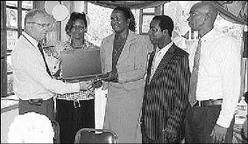
ACP John McLean (left) presents Woman Sergeant Daphne Miller-Goodin with a laptop for the Westmoreland Police Community Safety and Security office. Also in the photograph are Woman Constable Joan Evans (second left), Constable Mark Wright (second right) and Corporal Antonio Johnson. - File
Days before the implementation of a new community policing initiative, the constabulary's hierarchy is urging its members to adapt quickly to the more professional crime-fighting approach it will demand.
Assistant Commissioner of Police John McLean, head of the Community Safety and Security Branch, says members of the Jamaica Constabulary Force (JCF) must play their role.
Community policing is a concept of law enforcement, which focuses on building stronger relationships between residents and the force, to prevent or tackle crime and its root causes.
Upbeat about ripple effects
On the heels of a training initiative, involving 100 community policing officers, McLean is upbeat about the ripple effects when the programme is expanded.
"There's another 8,000-odd policemen out there and we need to make them aware of their roles and responsibilities," the assistant commissioner explained.
"They might not be dedicated to community policing but their action and deeds (will) reflect on the JCF, because everyone has got a role to play as far as community policing is concerned."
McLean adds that a public awareness campaign is critical to the success of the initiative.
Public perception challenge
Sgt Norman Cox, the crime prevention and community policing training officer, tells The Gleaner that one of the challenges is changing public perception.
"Some of the challenges that we find is that the public has stereotyped policing," he says. "There is still mistrust between the people and the police. That will only go over time, after partnerships are established."
Cox, who received formal training in crime prevention at the police college in Scotland, believes the fate of the project is in the hands of every member of the force.
"It is sort of new to the public, but even if they are sceptical at first, as long as our officers are professional in their undertakings, the public will eventually accept and appreciate our efforts.
"Internally, it is an even bigger challenge, because it is a cultural thing," he argues, "Our job now is to try and change that culture among our men and women."
Training sessions
The sub-officer and his team have been conducting two-week training sessions in police divisions islandwide, and believes that while conflict resolution was effective in addressing some issues, it had its limitations.
"Conflict mediation was effective but in most cases was not able to address the root causes of the problems, because most of the situations are dealt with at a station level. At that level, you don't have much interaction," he argued.
As far as McLean is concerned, his approach to community policing in Jamaica will not differ from his experiences in the United Kingdom.
The assistant commissioner says the crime paradigms in Jamaica and Scotland are similar, the major difference being the choice of weapon. The knife is the popular option in Scotland, while in Jamaica, the gun accounts for most homicides.
mark.titus@gleanerjm.com
Understanding the initiative
Some 38 communities, across the island's 19 police divisions, have been identified for the establishment of safety and security committees, which will consist of members of the JCF, the Social Development Commission and members of the respective districts.
Two communities in each division will be selected for phase one of the programme, with an incremental increase of at least 38 additional communities, each successive year, as resources permit.
The community policing initiative will be launched this Friday.