Leighton Levy, Contributor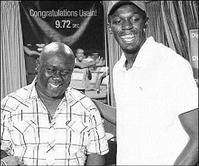
World 100m world record holder Usain Bolt (right) and his coach Glen Mills. - Photo by LeVaughn Flynn -Photo by LeVaughn Flynn
Casual analysis of Usain Bolt's world-record 100 metres run in New York on May 31, showed that the lanky sprinter covered the distance in only 41.5 strides, a not so remarkable feat considering that he is 1.96m tall.
On average, the world's best sprinters cover the distance in about 45 strides.
What is remarkable is that when he began to train with Glen Mills, almost four years ago, Bolt would have completed the event using even fewer strides, but he would have been nowhere close to Asafa Powell's world record.
When Mills took over as Bolt's coach, he immediately recognised that there were significant flaws in the youngster's technique. It was easy enough for the man, who has coached some of Jamaica's best contemporary sprinters from high school to the international level.
others transformed
Some of his charges have included Camperdown High School greats Leroy Reid and Carey Johnson, as well as Olympian Raymond Stewart. He also transformed Vincentian Kim Collins from an average performer into the Commonwealth Games and World Champion he is today.
To hear Mills talk about Bolt's technical flaws, it would be hard to imagine that the 21-year-old world record holder had actually run the 200 metres in 19.93 seconds at age 16. He is still the only athlete to run that fast at that age.
"Biomechanically, his body placement was not ideal for sprinting. His head was back, his shoulders were behind his centre of gravity, this resulted in him spending too much time in the air and over-striding (when an athlete increases his stride length resulting in him striding outside his centre of gravity and causing a 'braking' effect when his foot comes into contact with the ground) because there was a counter-balance between the pull of gravity and negative force and his forward momentum," Mills explained.
"We analysed that and what we found was that his core strength was very poor and we had to address that in an intensive way. Once we were able to reach certain strength targets we were then able to work on his sprint position."
And that was only the beginning. There were also some finer points that the new sprint king had to learn before he was able to start the process of transformation through drills, use of the medicine ball and plymometrics to develop his explosiveness.
"Our emphasis was to get him as technically correct as possible and that took us over two seasons," Mills explained, adding that he commends his young charge that he was willing to make the necessary adjustments over the past three years.
stride pattern evolved
Bolt's current stride pattern sort of evolved while he was working on improving his 200 metre race, his favoured event in which he showed marked improvement last year. In 2007, Bolt set a Jamaican national record of 19.75 seconds and was the silver medallist in the event in Osaka in 19.91 seconds. It was the fastest he had run consistently since he set the junior record five years ago.
"Last year we concentrated on correcting his turn running, making him more efficient around the curve," Mills said. "I felt that I could significantly improve his 200m. He was leaning inside on the turn and was unbalanced. We got him to lean forward and that contributed to him developing a good first hundred."
Mills explained that Bolt was also over-striding down the straightaway and we did a lot of work to correct that. That is how he developed his current stride pattern.
But even with his stride length adjusted, Bolt was able to outpace world champion Tyson Gay in New York pulling away as the finish line drew closer. "I honestly think we were on the same rhythm, except his stride pattern is a lot bigger," Gay said. "He was covering a lot more ground than I was."
Rough estimates indicate that Bolt's stride is about seven inches longer than Gay's. Gay finished second in that world record race in 9.85 seconds, the same time in which he won the 100 metres at the 2007 World Championships in Osaka.
"His length of stride is compatible with his height," Mills explained. "One of the reasons he has such a long but efficient stride is because he lifts his knees very well. He naturally has his stride length and it's an advantage for him, especially after his drive phase. That is a very powerful weapon for him."
The bad news for the world's sprinters is that Mills believes Bolt could be unbeatable in the near future. "He is not as strong as he should be," he said. "If he gets stronger, his stride frequency will improve and when we achieve that in perhaps the next two years, he is going to run even faster."