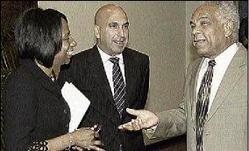
Dr Omar Davies (right), Opposition spokesman on finance, engages PSOJ chief executive Sandra Glasgow and PSOJ President Chris Zacca at the PSOJ Annual Economic Forum, Bank of Jamaica Auditorium, Kingston, Thursday. - Colin Hamilton/Freelance Photographer
Dr Omar Davies has advised Jamaicans, for the medium term, to put aside expectations for double-digit growth rates, suggesting that the best the country can deliver is around three per cent a year.
Significantly, the former finance minister's projection was challenged neither by his successor, Audley Shaw, nor Luis Alberto Moreno, who, like Davies, were presenters at an economic forum organised by the Private Sector Organisation of Jamaica (PSOJ).
Its theme was how to generate growth in the Jamaican economy while keeping expectations realistic.
Setting growth targets of 10 per cent, Davies told private sector leaders and analysts at a breakfast session at the Bank of Jamaica auditorium, would be unrealistic.
"We can look forward to growth in the medium term of three per cent," he said.
Global problems
Asked later for the reason behind his prognostication, the former minister cited global problems such as the rising prices for food and energy, and critically, the need for Jamaica to steer cash to social sectors to help deal with the chronic problem of crime and educational underachievement. The upshot: less spending on areas that provide immediate economic returns.
"There has to be a restructuring of the expenditure," Davies said. "This implies that there will have to be greater investment in the social sectors in the medium term."
Davies guided the Jamaican economy for 14 years until his People's National Party (PNP) narrowly lost last September's general election. While he has been credited with bringing a measure of macroeconomic stability and opening the island to the global financial markets, he is often criticised for the anaemic growth enjoyed during his tenure.
Reference to record
In fact, Shaw made a less than oblique reference to that record yesterday, pointing to during the 1990s while Latin American growth was humming along at five per cent a year, Jamaica was managing only one per cent. Indeed, only recently did growth near Davies' three per cent targets, only to be blown askew by a series of storms.
Shaw, who presented his first budget in April, projected growth of three per cent this fiscal year, and between three and four per cent up to 2011, in hailing distance of what Davies said was achievable.
In his analysis of the issues confronted by Jamaica, and likely to constrain growth, Davies placed high on his list the country's debt burden, the servicing of which eats a huge chunk of the national budget. The national debt is around 124 per cent of GDP, but the Government expects that with expansion in the economy and fiscal containment, this will fall to around 95 per cent of GDP by 2011.
Us economy problems
Davies also highlighted the problems in the US economy, stemming from the sub-prime mortgage crisis and the more fundamental shift in global trading and production relationships that had eroded American influence.
The first problem for countries like Jamaica is that, in an election year with an unpopular lame duck president in office, nothing fundamental will happen.
"The present president doesn't have the political clout to do anything substantial," Davies argued.
It was important, however, for Jamaica to diversify its trading and economic relationships. A longer-term growth strategy "must build-in diversification from the US economy," Davies said.
business@gleanerjm.com