Contributed photos
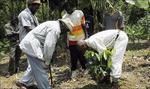
LEFT: Danny Simpson (right), regional forest officer at the Forestry Department, separates two Honduran lumber trees on Michael Chen's (left) plantation. Looking on are Alton Henry (in tam), forest warden, and workers on the farm.
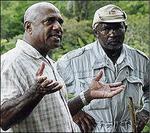
RIGHT Tree planter Michael Chen (right) listens attentively as Danny Simpson, regional forest officer at the Forestry Department, explains how to cultivate pineapple plants on slopes to prevent soil erosion.
Elaine Hartman Reckord, JIS Writer
In Jamaica's hilly terrain, you'll find damaged roads, houses, trees and vegetable crops, which are often covered or removed by mudslides. The destruction continues downstream where the fish and reefs are affected by the silt washed into the ocean - and it all points to one big problem - soil erosion.
Every year the Government spends millions of dollars to remove large amounts of silt and debris caused by soil erosion from roadways, especially after heavy rains associated with hurricanes. So the question is, can soil erosion be controlled?
There is certainly one way to deal with it.
In eastern St Thomas and other parts of the island, there is a tree planting exercise taking place to help control soil erosion. This is not a new project; it began some 20 years ago, but intensified after the 1980s. It is part of the private tree planting programme managed by the Forestry Department, whereby small and large landowners are being encouraged to plant trees, which would provide watershed protection and prevent soil erosion.
Support the programme
To support this programme, the Forestry Department, in collaboration with other agencies, has started a public education programme to highlight the importance of the forest environment.
Meanwhile, Government has allocated some $13 million for activities to protect natural resources as well as some $1 million to public education to create greater awareness of the importance of the environment.
The Forestry Department is also establishing local forest management committees to involve citizens in managing the watersheds and forest areas. Several committees have been established in Bunker's Hill, Balaclava and the Wait-a-Bit areas and also the Buff Bay watershed in St Mary.
Michael Chen is one of the many landowners in St Thomas, who since 1996 has been planting trees. Currently, the trees are between six months and 10 years and they will be mature in another 20.
"When we get heavy torrential rains, the water washes the soil down into the rivers and gullies and ultimately into the sea. The trees serve as a buffer to hold that water from washing so fiercely down. The roots hold the soil and the trees' foliage prevents the water from impacting on the ground and washing the soil away so ferociously," explained Chen.
Asked how many trees he had planted so far, Chen said with pride, "thousands". On the 40 and 50-acre land, he has a variety of lumber trees, such as the mahogany, mahoe, Spanish elm, cedar and the Caribbean pine on the foothills of Blue Mountains. Chen said trees could be intercropped with fruit trees and short-term crops, such as ackee, coffee, citrus and other food crops. If this was done, then income could be earned until the lumber trees mature.
According to Chen, not much preparation of the land was required for planting. However, he noted, it was important to clear the shrubbery before putting the seedlings into the ground so the trees could grow without competition from wild plants. He warned that it was not necessary to do wholesale clearing of the land or "slash and burn" and, most important, he said, "one should never cut down trees to plant trees." After three years, the trees would be fit to compete with other wild species.
Apart from beautifying and protecting the landscape, trees could be seen as a lucrative long-term investment.
Level of investment
"The investment that you put into tree planting is proportionately very small when compared to the possible returns. The greatest investment is in patience because you are not going to see the returns within five years, within 10 years possibly," said Chen.
"But you also get a certain personal fulfilment from this type of enterprise, from planting a tree as a seed and watching it grow over the years," he added.
Chen said trees are one of the most significant elements in our water cycle and our climate phenomenon. In other words, trees are very important to sustaining our climate and our weather pattern. He admitted that there were challenges as a private tree planter; drought, disease infestation and wild fires were some of the most obvious ones.
Protecting the trees
"There are a number of things we have to look out for, some we have control over, some we don't. We just utilise proper mitigation methods and protect the trees as best as we can," he said.
He is quite encouraged by the support he has been receiving from the Forestry Department, which has provided him with seedlings and technical advice free of cost. Danny Simpson, regional forest officer at the Forestry Department, described Chen as one of the "exemplary and outstanding" farmers.
"At present, over 200 farmers, mostly from Portland, St Mary and St Thomas, are involved in the project," said Simpson.
"The list is increasing," he added.
According to Simpson, there was a regular supply of seedlings to meet the demand. Seedlings are produced at three nurseries, at Mount Airy in St Andrew, Moneague in St Ann and Williamsfield in Manchester.
Simpson also said the department had intensified its efforts in the Yallahs watershed area to encompass as far as Hagley Gap, on the border of St Thomas and St Andrew.
"The soil in that area is very delicate and fragile. Even during the dry period you have landslides," the forestry officer la-mented, adding that some farmers still do "slash burning" just to create space for their farming. "You have to fix the watershed first in the mountain. So no matter what is happening at Yallahs, if you don't fix the problem in the hills, you will always have the problem down stream," he added.