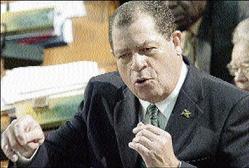
Minister of Finance and the Public Service, Audley Shaw, making his opening contribution to the 2008-2009 Budget Debate in the House of Representatives, April 10. - Rudolph Brown/Chief Photographer
Citing the government's commitment to fiscal discipline, debt reduction and economic growth, Standard and Poor's yesterday maintained its 'B' credit rating of Jamaica's debt.
But even as the rating agency declared the island's outlook to be stable and it appeared broadly upbeat about the economic policies of the Golding administration, Standard and Poor's projected economic growth this year is at two per cent, a full percentage point below the projection of finance minister Audley Shaw in his April budget.
"The gross domestic product (GDP) outlook for 2008 is two per cent and incorporates the impact of the slowdown in the US, Jamaica's main trade and tourism partner," the agency said.
It added: "However, ongoing gains in construction, recovery of the agricultural sector and a still-strong tourism sector (demon-strated by robust first-quarter 2008 results and advanced bookings for newly opened hotels) should counterbalance the negative pressures."
Assessment of debt
This was the first formal assessment of Jamaica's sovereign debt by a global rating agency since the Jamaica Labour Party came to office last September and, despite its areas of caution, is likely to be heralded by the Bruce Golding administration as vindication of the policies it has pursued for the past eight months.
"Supporting the ratings are the Government's commitment to fiscal discipline, debt reduction and economic-growth reinvigoration," Standard & Poor's said in its report prepared by credit analysts, Olga Kalinina and Roberto Sifon Arevalo. "Jamaica's local capital markets, which are well developed compared with those of its peers, and political stability, are also rating strengths."
But while Standard and Poor's maintained a stable outlook for Jamaica, the agency warned of lurking vulnerabilities.
It said the island's rating has been constrained by the Government's debt burden, limited fiscal flexibility and susceptibility to external circumstances.
After a long stretch of anaemic growth - averaging 1.6 per cent over the past decade - the Golding administration is keen to rev up expansion of the GDP, projecting growth this year of at least three per cent.
Analysts had argued that barring natural disaster or some unforeseen economic catastrophe, this should have been easily achieved.
In 2006, growth was 2.6 per cent and the country appeared to surpass that last year until things were set askew by mid-year storms. Eventual growth in 2007 was approximately one per cent.
There was no immediate official response to Standard & Poor's sharply lower forecast, which came despite the rating agency having touted the achievement of growth as "one of the main goals of the Jamaica Labour Party".
The agency did, however, stress that growth in Jamaica continued to be hampered by the crowding out effect of the "government's high borrowing needs", as well as labour-market rigidities and high security costs.
Debt-reduction strategies
Standard & Poor's did, though, seem optimistic about the administration's fiscal and debt-reduction strategies, celebrating Shaw's achievement in holding the fiscal deficit in the past financial year to 5.4 per cent of GDP, and new borrowing deals with financial institutions.
These, with promised tax reforms and the privatisation of loss-making state companies should help achieve projections for a balanced budget by 2010 and further drag town the national debt as a percentage of GDP. The debt is now around 126 per cent of GDP.
business@gleanerjm.com


















