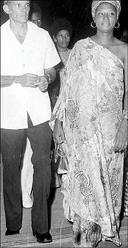
Beverley Anderson-Manley, who oozed Afrocentric flavour in her hairstyles and couture in the 1970s, arrives at the Little Theatre with husband, Prime Minister Michael Manley.
By the time I was seven or eight, I had lost my baby fat and become thin as well as tall. I was always the tallest in my class and felt strange and awkward. I had huge eyes and thought I was ugly. I was also the darkest in my family and my mother often compared me with my father, who by then had fulfilled all the prophecy of my grandparents and turned out to be good for nothing, as all blacks were - at least that was how my mother put it.
Because my colour was unacceptable, like my father's, my destiny too was to be good for nothing. My mother told me this constantly, and I soon developed a defence mechanism. I withdrew into myself, became very quiet, and struggled constantly to prove that I was as good as my sisters, regardless of what Mama said. This withdrawal would suddenly erupt into something quite different whenever my mother accused me of something I felt as unjust. My colour was God-given and I may have been part of a race that was unacceptable, but some things - such as my sisters relaxing while I was made to do housework - I railed at having to put up with it.
My 'brown' sisters were not allowed to help. I was resentful, yet there was a sense in which I accepted this was the role of the darkest one in the family. Until I was in my '50s, I thought of myself as very dark, because in my family I was always called 'black'.
Few refrigerators
During those days, there were few refrigerators in homes and the ice company would deliver to individual houses. We used to take 25 lb of ice, and I was the one who had to haul it from the truck to the icebox in the kitchen. On one of those mornings, I dropped the ice on my toe. I can still feel the pain. I screamed, then quickly shut up, picked up the ice and took it into the house. Only after I had placed it in the icebox did I run away to cry. I just could not deal with another flogging. My toe hurt for days, and when I put on my shoes the pain got worse, but I bore it quietly, the way I knew my mother would have wanted me to.
My sister and I always shared a double bed. We enjoyed sleeping close together, and it provided comfort, particularly when my father returned home drunk at night and our mother started cursing. In spite of her response to his drinking and philandering, he never stopped. We girls would huddle close together, hoping that things wouldn't get violent. We also hated it when we heard our mother cry. This was a heart-rending sound like a dog howling. We couldn't handle hearing this from our Mama, a woman who seemed so strong.
One night, she attacked my father physically, and when he hit her back, she slipped and fell. We lived above the railway station in Old Harbour then. I was 12 years old. We were in bed, as usual, when Daddy came home drunk. She cursed him about the usual things - his drinking and his current sweethearts. She was concerned about one in particular, who was the latest postmistress to arrive in town. Mama knew her by name. We heard her scream as her body hit the floor. Because we were always expecting something horrible to happen to one or both of them as a result of their quarrels, our darkest fears had now been realised. Daddy had hurt Mama physically.
Adhesive bandages
We ran out of our bedroom to help her. I can hardly remember what happened after that, but suddenly, everyone was helping her up off the floor and we were all frightened. Later, we would learn that she had sprained her back. She had to wear bandages around her torso and, therefore, also around he small child-feeding breasts and down the length of her body to just short of her abdomen. The adhesive bandages stuck to her, and she had to use Johnson's baby powder to soothe the inevitable itching and discomfort. But she still had her housework to do and carried on. The sprain was just one more cross to bear. Things would be so much easier for the entire family, I thought, if Daddy would just stop drinking, stop philandering and come home to us at night.
In many ways, my father was a mystery to me. During the week, he worked long days and many nights. In-between, he would frequent the rum bar, which was always close by, and visit his sweetheart of the moment. My father was also involved in an organisation called 'The Lodge' - the Masonic Lodge. My mother teased him about it, trying to find out more about this secret group, but she never got answers to her probing questions, such as 'Did they brand you like a cow when you became a member?'
Serious church duties
On Sunday, however, everything changed. My father was a lay preacher in the Anglican Church and he took his duties seriously. Whenever he preached or partici-pated from the altar of the church, even his accent changed to one that sounded British and authoritarian. He became the father we did not know when he was preaching from the pulpit. Everyone said that he had a way with words. He was a good communicator and a powerful preacher. His tones were mellow and he knew how to colour his words. I often wonder if my communication skills and my voice came from him.
Clean 'priestly' robes
By Friday, my mother would have his 'priestly' robes clean and ready for Sunday. These were long gowns, white over black, and had to be impeccable. In the meantime, he would do the research for his sermon and then sit at an old typewriter, pecking away with one finger. During this preparatory period, he would sometimes spend a great deal of time in the bathroom where it was peaceful and quiet. My mother would keep telling him to hurry up. He would reply in his British accent, 'Don't bother me now, Esmine. Don't you understand I am doing my ablutions!' I always wondered what he was doing, locked up for so long in the bathroom. Did he do something different from what we did in the bathroom? Was this something to do with being a man? When Sunday morning arrived, he would dress up in robes, Bible in hand, and assume the aura of a holy man.
Lay preaching
It was important to Daddy that we observe him in church. Wherever we lived, he would be involved in lay preaching. In our earlier years, while we lived in east Kingston, he was with St George's Anglican Church in downtown Kingston, which was run by Canon R.O.C. King. Then there was the church in Old Harbour that we attended with him, although we were members of the Brethren Church. Later on, in Spanish Town, the Anglican cathedral was under the leadership of Canon B.C. Jones. We children would go whenever our father was preaching. Our mother never went, although she approved of our going. Her job was to ensure that, just like Daddy, we were well turned out for church in our Sunday best. Daddy would seat us in the front row and then go to the vestry to put on his 'vestments' and get ready for the procession into the church with the rector and other clergy.
Soon, however, Roma and I were given to giggling so much that we were moved to the back. We laughed at everything. In church, everything seemed funny. No matter how our parents admonished us, we couldn't help ourselves. Finally, Daddy had what he thought was a brilliant idea. He decided to make us sit in separate areas. But Roma would look around to see where he had positioned me and I would do the same, and the minute we saw something that amused us both, we would be eyeing each other and laughing again. Over the years, the giggling never stopped.
Tomorrow:
Bev's political awakening
Even as a child, I was fascinated by the way Norman Manley spoke. His words were slightly, ever so slightly, muffled, uttered in a sing-song way and as if he had cotton in his mouth, and a whole generation of Jamaicans would try to talk just like him.
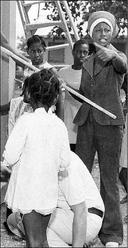
A Gleaner file photo shows Beverley Anderson-Manley rallying the 'troops' as they repaint Maxfield Park Children's Home in a Labour Day project in 1974.


















