Mark Dawes, Staff Reporter
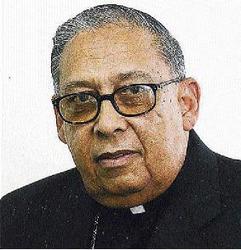
The Most Rev Lawrence Burke, former archbishop of Kingston. - Contributed
(Today, The Gleaner presents part two of an interview conducted with the Most Rev Lawrence Burke, who earlier this month retired as archbishop of Kingston.)
Gleaner: The Roman Catholic Diocese of Montego Bay has launched a major evangelisation programme. Is there something similar taking place in the Arch-diocese of Kingston?
Burke: This a very key part of our programme in the archdiocese as well. We have had a number of training programmes for evangelists. We are trying to re-emphasise in the church that the call that we have for baptism is a call for witness and evangelisation. Historically, the Roman Catholic Church, in my mind, has not given sufficient emphasis on the word, the evangelion, the good news. We have stressed a lot our sacramental life, and not stressed sufficiently the word. I am very happy the synod of the entire church this year to be held in Rome is on the word of God. I am hoping that this is going to bring new impetus to our own local efforts to emphasis the need for the word. Ecumenically, this is one of the things that we share with our Christian brothers and sisters, the word of God.
Opportunity for leaders
I think that our deacons, priests and bishops need to use the opportunities that we have now of our Sunday gatherings to emphasise more the word of God with our people. Be better prepared and to bring to bear the light of the gospel and the power of the scriptures on the things that are affecting peoples lives - their personal struggles and the national struggles, our economy our policies and so forth. The role of the laity is to use faith to transform society. We are not theocracy here where the church dictates to the Government what it should be doing. Faith should direct how we live, whether it is our private life or the public arena.
Is there a role for Jamaicans living in the diaspora to play in augmenting Catholic witness in Jamaica.
Absolutely. Some of the greatest support that our Catholic schools have, like Alpha Academy, Immaculate Conception High School, and St George's College, come from graduates of these schools who are now living in the diaspora. They remit much help for the breakfast and feeding programmes in these schools. Even though these are the old time 'recognised' schools, you would be surprised to know that a lot of those students who are coming to school need a lot of help. In the area of education, they are already very active. In the other areas of witness, a number of our programmes that the Catholic Church sponsors here are - for example, the work of the Mustard Seed Communities. The work of the Missionaries of the Poor is financed by Jamaican Catholics who are living abroad. So both in education and social work, we get a lot of assistance from Jamaican Catholics living abroad. We probably need to set up a way in which we can have them help us in the parish structures, where we are actually doing more of the work of the evangelisation and formation of our people.
Social service organisation
One of the things that I am fearful of is that people look at the Catholic Church as an organisation for social services. We tend to forget that the social services that we give, the source of that energy comes from the formation received in the parish. It comes from our faith. Our self-understanding as children of God, and our recognition of every human person as being a child of God. Therefore, having a dignity that no one can give them except the Lord and which no one can take away from them. This is what puts fire in our guts to reach out and carry on these programmes. If that spirituality is not behind the social programmes then it is just another humanitarian social apostolate which has a certain amount of goodness in itself. The social programmes the church carries out come from the spirituality which forms us as Catholics. A lot of people don't understand that. A lot of people don't look at the Catholic Church as a place where you go for prayer and spiritual stuff - it is always a place you go to receive some help.
When do you think Rome isgoing to give Jamaica a cardinal?
Normally, cardinals are appointed in populations where there are a lot of Catholics. Until we get a flourishing Catholic community in Jamaica, and the rest of the Caribbean, I don't think we will have a cardinal.
Maybe this is something the entire region needs to look at. I don't think it will happen in my lifetime. I think it is something that would pick up the spirits of the people knowing we have someone at that level.
Have you met Pope Benedict XVI and how would you rate his performance as the bishop of Rome?
I met him previously when he was cardinal, especially when he was Prefect of the Congregation for the Doctrine of the Faith. Many of his decisions might have seemed harsh in that particular work. He was trying to protect the orthodoxy of the church and its tradition. Personally, through all of this, I have always found him a very gentle person, and a very pastoral person. On April 8, I returned from Rome with all of the bishops from the Caribbean. We attended meetings with the Holy Father - personal meetings with him and we had a group meeting with him. And again he was very warm, very personable, and showed great interest in the work of the Caribbean. It was a very helpful meeting and very inspiring.
How soon will the Vicariate of Mandeville get a bishop?
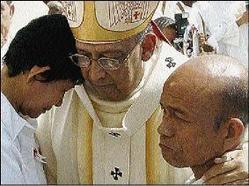
Archbishop of Kingston Lawrence Burke (centre) comforts Mauricio (right) and his wife, Conrada, during the liturgical celebration in thanksgiving for the slain priests, Suresha Barwa and Marco Candelario Laspuna, held at the Holy Trinity Cathedral in downtown Kingston, on November 12, 2005. The couple, who are the parents of Marco, had travelled to Jamaica from the Philippines to attend the funeral. - Norman Grindley/Deputy Chief Photographer
That process is not in our hands. That process is very far gone. Our information is that it should not be too long now. Part of the delay, I think, was related to some reflection as to whether we were going to continue to have a third diocese in Jamaica or whether we were going to go back to having two diocese. The whole consultation took a little while longer. After hearing from the people of Mandeville, who were very upset to think that they would not continue to be a diocese, I think they are now well along in the process. When we were in Rome we were given an assurance that this should be resolved very soon.
How healthy are you?
One of the disappointments I had was that a year after I came here and was trying to figure out what was going on locally, for I had been away for 23 years, and Jamaica had changed drastically in 23 years, and just when I was sort of getting on top of the situation, I found I had colon cancer.
I have had surgery, and gone through chemotherapy and the first series of chemotherapy knocked me out quite a bit and I was not as available as a leader of an archdiocese should have been available to people. Since then, the cancer has spread to my lungs, and there is the possibility of going to my liver. I started a new set of chemotherapy. I lost all of my hair and they tell me I look much younger without my hair. I have been tolerating it very well. I feel very good. I get an assessment very regularly. I am feeling good. Although it has been in many ways a disability, cancer is also a gift. It gives you a whole new perspective on life.
A lot of people look upon me as very strong, some call me heroic - which I don't think I am. People see my tenacity, working every day in my office and going to all these public functions, they take a lot of hope from that. In many ways, they see this as a partial fulfilment of what St Paul said about how God can use the weak to confound the strong. I don't take credit for it. But, in many ways, cancer has been a gift. But, as I said, I am feeling good. I leave it in God's hands. As long as I have the strength and the energy, I am totally committed to whole question of establishing the reign of God, the kingdom of God. And that kingdom we believe is not a kingdom that exists only in the next life, but it has its beginnings here - a kingdom love, righteousness, forgiveness, peace. These are the things I think every human heart yearns for.
I thank God for the opportunities I have had as a poor young man growing up in Vineyard Town to serve the church at this kind of level and to be able to touch people's lives, to work and rub shoulders with, and listen to and serve some of the poorest people in the world and also to have had the opportunity to meet what some people consider to be some of the great leaders of the world. I have enjoyed it tremendously. I have really been blessed and I thank God for every gift He has shared with me, beginning with my family, and this great country of Jamaica, my vocation as a Jesuit and the formation I received, the motivation I received with that formation, the opportunities to serve at these different levels of the church. I have no real regrets and I have loved it.
Do you think God is speaking to you a particular message through your cancer?
I have not given a lot of thought to that. You know we run a very hierarchical church, although we have great consultations it is the bishop or archbishop that really takes responsibility for everything. For many years, whether I was Jesuit superior, principal of St George's College, arch-bishop in The Bahamas, archbishop in Jamaica, in many ways I was in control. And yet on reflection on my life, in many ways I have been most effective when I was not in control. I think one gift that you receive through cancer, is that you are really not in control. Therefore, you have to let go and let God (take control). Although I have never thought of myself as exercising authority in any arrogant way, I think that the sickness has confirmed a fact - you can't be in so much control that you control people's lives, that you also need to let go, you have to let people exercise their own freedom, you have to let God exercise His work in your own life. I think if God is saying anything to me, it is that sometimes when you are not in control you can make your best response to the invitations that God gives to you.
What do you hope to do in retirement?
I am going to move into a retirement home that we are just finishing up for our diocesan clergy. I will assist the new archbishop in any area that he wants me to assist him. In my first few months, I would like to visit a number of my family and Jesuit friends, and other friends I have not seen for four or five years. I want to contribute to the life of the church in Jamaica. I have been doing a little care of orchids. I hope to do some reading. I bought so many books, I hope I now have a chance to read them.
Send feedback to mark.dawes@gleanerjm.com. Editor's note: See also an earlier Gleaner interview with Archbishop Lawrence Burke on http://jamaica-gleaner.com/gleaner/20040515/lead/lead4.html.


















