Political argument being a passionate thing, there will be times when, without warning, tempers flare and language tumbles to a low degree. Now and then the verbal conflict might even threaten to become physical. Such sudden and inevitable extremes can hardly be avoided; especially where many of the people's watchdogs are new and have never been house-trained.
So, those of us who stand aloof from the parrying of politicians, need hardly be offended. Better to treat the odd occurrence with understanding and good humour.
Some years ago, the then Speaker of the House of Commons, Bernard Weatherhill, came to Jamaica for a conference on parliamentary behaviour. He gave some advice, which Mr Montague and others of his ilk might take to heart:
"You may not in any of our parliaments attribute dishonour to any Member of Parliament. You can't say, "You're dishonest". That is absolutely unparliamentary. You can perfectly well say your policies are dishonest. We are all honourable members, so we treat each other as men and women of honour and with the courtesy of opponents. But, there is no reason why we shouldn't be hard-hitting in our debates..."
Symbolic line
Mr Weatherhill went on to suggest that Jamaican parliamentarians might consider copying the British by drawing a symbolic line on the carpet between the Government and Opposition at Gordon House. He said: "In front of my chair are two broad red lines, exactly two sword lengths plus one foot apart. They are a daily reminder to us of our parliamentary tradition. That is, the settlement of disputes by the word rather than the sword."
The lines referred to by Mr Weatherhill were drawn in the House of Commons in 1711, after a government back-bencher, Sir Terrence Guttersalt, unsheathed his sword and proceeded to kill two Opposition members and injure three others. The incident, known as the Tragedy of the Commons, may have influenced Mr Weatherhill's own conduct. His strictness once caused him, during the Thatcher administration, to rule the word 'poppycock' as out of order. I wonder what he would have done were he to be confronted with 'bangarang'.
Unruly meeting
In April of the very same year that Guttersalt committed his assault, the Speaker of the Jamaican House of Assembly, Peter Beckford Jr, found himself in difficulties when he tried to adjourn an unruly meeting. The legislators objected, drew their swords and ordered him to remain in the chair. Hearing the commotion Mr Beckford's father summoned the Governor, Sir Thomas Handasyd, who grabbed his sword and, accompanied by the sentinels, broke through the doors and declared the Assembly dissolved. The unhappy ending was that during the fracas the elder Beckford slipped down the stairs and later died of his injuries. Beckford Street in downtown Kingston is named after him.
Less fatal and more amusing was the incident that governor Sir Edward Trelawny reported to the House of Assembly in August 1742. He called that special meeting to tell of how he and Sir Chaloner Coke, had resorting to swords in settling a dispute that had spilled over from Parliament to the Governor's own house. Trelawny told the House how Sir Chaloner had visited him and had heatedly referred to another member, Mr Dicker, as a scoundrel and a rascal. When he responded that Mr Dicker was no more a scoundrel than Sir Chaloner, the latter shouted, "He's a God-damned scoundrel!" and placed his hand upon his sword. The governor continued:
"It has been reported that his sword was so rusty he could not draw it. Upon my observing these motions I put my hand to my sword." And he admitted that because of "the rustiness of my sword. I could not get it out. What words, if any, I might have made use of in return to Sir Chaloner's language and behaviour, I cannot recollect." The matter ended up in court and Chief Justice Kelly stated that the jury's verdict was in favour of the governor. However, he halted the case and exacted no penalty.
Chair smash threat
Back in 1954, Alexander Bustamante raised a chair and threatened to smash it on the head of the Hon Theodore Williams who had made a snide remark about the ancestry of those members elected by the majority. The Chief was successfully restrained, as he was on another occasion when he became annoyed with Felix Toyloy, one of his own JLP members. That row, which began inside the House, ended up on the veranda with other parliamentarians pulling the two apart. Onlookers in the street watched both with amazement and amusement. In neither instance did the speaker find it necessary to rule or suspend. However,Williams almost immediately resigned as member of the Executive Council, the Legislative Council and also his post as Custos of Westmoreland.
Mr Tony Spaulding was another hot-tempered debater. He got a six-month suspension for loudly defying Mr Speaker, calling him dishonest and hurling four-letter words at those trying to intervene. After that, the dispute became a PNP-JLP battle; and public statements were issued from both sides. Speaker Talbert Forrest gave his account:
Shouting
"Mr Spaulding defied my orders to sit no fewer than five times, shouting loudly and defiantly at each order to sit, "I will not." At this point, I suspended him from the rest of the sitting at which he responded, "You can suspend me for life! You have the ... you have handled it irresponsibly; you are immature, you are dishonest ...."
"It was at this point that I was obliged to "name" him and call upon the Leader of the House to move for his suspension from the services of the House. Again he defied the motion moved for his suspension for the rest of the sitting and when the Marshal was summoned to remove him he thundered, 'I want to see who going put them hand 'pon me. I want to see that.'
"It was clear that additional force would have been necessary to remove the member from the House and its precincts. I suspended the sitting and summoned the Officer in charge of security to my office and, together with the Leader of the House and the Clerk, issued certain instructions."
The PNP leader, Michael Manley, thought that there was "strong provocation" and that the punishment was excessive; but he issued a statement saying: "Mr Tony Spaulding was in error in several respects. He was wrong in disobeying the Speaker of the House, in attacking the Speaker in the way he did, in refusing to leave the Chamber when ordered to, and in using indecent language in the precincts of Parliament."
Swiftly removing the Mace
Another six-month suspension was received by Mr Keble Munn who did not raise the level of his voice. Instead he demonstrated his disagreement by swiftly removing the Mace from its place and heading for the door, thereby bringing the sitting to an abrupt end. That was in '69, 19 years after the maverick F.L.B. Evans had done the same thing, for the first time. He got only one month's suspension. Then there was Maxie Carey, who repeated the offence in 1968 and was barred for two months. Winston Jones, usually urbane, was suddenly forthright and earned a fortnight's suspension. His punishment was for insulting the Chair by shouting "Damned nonsense!"
Mr Mike Henry was more respectful of the speaker's authority and took his seat when ordered to. He had been out of his chair and walking, in response to Terry Gillette's challenge to "come jump in me chest". Henry, without needing a mike, retorted loudly, "Anytime you ready I can jump in a it." His motion towards Terry was overruled by Speaker Cunningham firmly declaring, "Mr Henry, I am on my feet, will you sit." The member complied, order was restored and Gillette avoided a close shave.
Not all members of Parliament find it necessary to resort to violent sounding words and phrases. Winston Churchill was a master at wounding his opponents with sharp but stylish speech. He once described Clement Atlee as "a sheep in sheep's clothing" and "a modest man with much to be modest about." He knew that to call a fellow member a liar is just cause for rebuke by Mr Speaker; so Churchill described one of his foes as the user of a "terminological inexactitude." Another member once cleverly claimed a slip of the tongue in referring to an opponent: "Mr Speaker, rather than respond to my detractors I will let lying dogs sleep." Yet another, wishing to call his foe a former fowl thief, remarked: "Mr Speaker, when my honourable friend was a schoolboy, the disappearance of fowls in the neighbourhood was a common occurrence."
Ejected twice
Those quips, are in contrast to the naked barbs of Tam Dalyell who was twice ejected from the House of Commons for calling Margaret Thatcher a liar.
Not satisfied with painting the lady as "a brazen deceiver" he added, "She is a bounder, a liar, a deceiver, a cheat and a crook." The "Iron Lady" was not amused and for 17 years after that the two never exchanged so much as a syllable. Not to worry. One evening, following the prolonged mutual muteness, the two were seen "getting on famously" at a Colombian Embassy dinner.
Looking at all of this, it should be clear to everyone that the rough and tumble of politics is not for the squeamish. The active players are required to have an extra layer of skin and a facile tongue prepared for rapid response. It is easy for others engaged in less competitive work to scold, cajole and ask them to be exemplars of good behaviour. The fact is, as Bustamante once declared, "MPs are not doll babies or Sunday school boys."
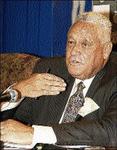
Mike Henry is more respectful of the Speaker's authority than others.