John Myers Jr, Business Reporter
JAMAICA HAS warned that it will override any Guyanese resistance to its request for a suspension of Caribbean Community's (CARI-COM) 25 per cent common external tariff (CET) on the import of up to 24,000 tonnes of rice, a move aimed at guaranteeing domestic demand for the commodity at the lowest possible price.
"We are not afraid to take the steps apprpriate to secure the interest of the Jamaican consumers," Karl Samuda, the industry and commerce minister told the Financial Gleaner.
"Our importers have lost faith in the supplies from Guyana," Samuda said. "We cannot, as a member state, put our population at risk."
Guyanese shippers wary
CARICOM is a fledgling economic union between 14 regional states of which Jamaica and Guyana are both members. Guyana is one of the community's two rice producers - the other is Suriname - and normally supplies about half of the estimated 100,000 tonnes of rice consumed here annually.
But with the rising price for the commodity globally, as well as a growing number of extra-regional clients, Guyanese shippers have been wary of entering the six-month forward contracts that have been requested by Jamaica.
The Guyanese, officials here say, want to limit forward agreements to a month, a matter that was not resolved despite a visit to Kingston last week by Jagnarine Singh, the head of the Guyana's Rice Development Board, to assure rice importers that his agency is a reliable supplier.
However, Jamaica was not assuaged by Jagnarine's assurances and this week Kingston formally applied to CARICOM's Council for Trade and Economic Development (COTED) for an immediate suspension of the CET on the import of 4,000 tons of rice monthly for up to six months.
Guyana has not yet staked out a formal position on Jamaica's move, but the country's agriculture minister, Robert Persaud has recently been arguing that there is need for the suspension of the CET. Guyana, Persaud has insisted, can adequately supply the Jamaican market.
Samuda, who has been in a battle with Guyana since late last year over the length of forward contracts, says he has asked Jamaica Rice Milling, a subsidiary of United States (US) farming and commodities giant, Archer Daniel Midlands, to examine the possibility of forward purchase and the proposed system.
"The Government is prepared to enter into an arrangement whereby forward supplies are pinned down and the supplies are distributed within the trade to the various distributors, who would otherwise be importing from Guyana," Samuda told the Financial Gleaner.
Such supplies would most likely come from the US.
Derrick Nembhard, Jamaica Rice Milling's CEO, said yesterday that his parent company, ADM Mills would be capable of supplying Jamaica's requirement, once a deal was struck.
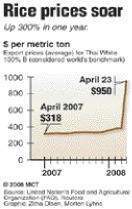
Like elsewhere, the price of rice has been rocketing on US commodity markets, but it has been suggested that it would be cheaper to source the product from the United States than Guyana, once the CET is removed.
In the case of Guyana the cost of rice imported by Jamaica, up to a fortnight ago, had jumped by a third to $2,375 per 45 kg bag.
That price was four per cent cheaper than imports from Guyana, which does face a tariff in the Jamaican market.
While the suspension of the CET would make US and other third country rice more competitive here, notwithstanding the scarcity and price spike globally.
"We are taking the appropriate steps to import rice from the United States in the first instance (and) this applies to every product that we regard as being crucial to the survival of the Jamaican people, especially the most vulnerable in the country," Samuda said.
john.myers@gleanerjm.com