Linda Hutchinson-Jafar, Business Writer
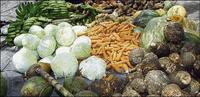
Food displayed at a market in Kingston. Caribbean countries are now stressing reliance on internally generated crops as one way of keeping prices in check and supplies consistent.
- Norman Grindley/Deputy Chief Photographer
Trinidad and Tobago is reaching back for old plans to combine with new proposals under a rescue strategy for food that aims to boost agricultural production in the twin island and reverse, or at least put the brakes on three years of consistent price increases.
The cost of food was 20.7 per cent higher in January than a year ago, according to new inflation figures, prompting a call from central bank governor Ewart Williams Monday for programmes to boost cultivation of fruits and vegetables.
A day later, Consumer Affairs Minister Peter Joseph told Parliament that the Patrick Manning-led government was hunting cheaper food imports from South America and Central America as a short term measure, to complement other medium and long term plans to tease higher yields from Trinidad's farms.
"There is no over-emphasising the fact that the need to rely on locally produced food will increase as global realities make imported foods increasingly scarce and increasingly expensive," said Joseph who is also the country's legal affairs minister.
There was no immediate indication as to what these measures would cost.
For now, Trinidad is looking first to Caricom partner Guyana for imports of 15 agricultural items, including ginger, pineapples, green plantain, pumpkin, rice and sweet potato.
That plan is being pursued under the 'Guyana Initiative', a programme which allows Caricom partners access to land for agricultural production, including agro-processing.
Fast ferry service
CMC reported Tuesday that the food import plan calls for the establishment of a fast ferry service "for the transportation to Trinidad and Tobago of mainly farm products from the countries of the southern Caribbean," according to Manning.
At the same time, Taylor said, infrastructure works were ongoing on lands that were given over to more than 700 former workers of the state sugar company, Caroni Limited, to farm.
By the end of June, Taylor said 5,700 of the 7,000 two-acre sized plots would be ready for the 700 farmers to go full scale into production.
Infrastructure works are also underway on another 13 commercial farms on six sites, averaging between 100-300 acres.
As time progresses, Trinidad also plans to give over more lands to farming, but this Joseph said is part of the government's long-term plans.
Key to the administration's food rescue strategy is efficiency and volume.
In that regard, the state-run Chaguaramas Development Authority and the Ministry of Housing, Planning and the Environment have jointly established a farm utilising the Cuban agricultural model.
Called the Large Farm Project, it involves the operation of a 200 acre farm in Tucker Valley in the western region using several technologies for growing food.
The farm is expected to bring its first produce by November.
Training centre
PCS Nitrogen, an Ammonia Manufacturing Company is also creating a 75-acre demonstration and training centre large farm on land provided by the state, with start-up operation expected by August or September.
Crops to be harvested include sweet potato, cassava, tomatoes and paw paw.
Joseph on Tuesday also urged Trinidad's 1.3 million population to use more locally produced foods, and opt for root crops for processing by-products such as flour, as substitutes for the traditional carbohydrate staples of wheat, rice, white potatoes and pasta - saying this would require shifts in taste and consumption patterns.
Jamaica's Agriculture Minister Dr Chris Tufton last week placed a similar proposal on the table - his suggestion was greater exploitation of the tuber, cassava.
"It is imperative that we both accept and realise that if we are not to continuously remain completely vulnerable to the vagaries of the international market, we must quickly readjust our focus towards the consumption of more locally produced foodstuffs," said Joseph.
"We must, as far as it is possible, eat what we produce, and produce what we eat."
Primary agriculture is an economically small but socially important sector in Trinidad and Tobago.
Agriculture GDP was 1.02 per cent in 2004, but a significant employer - accounting for 5.0 per cent of the workforce - and key to the rural economy.
The sector has been in relative decline for several decades, falling in absolute or real terms in 2003 and 2004.
Between 1984 and 2004, its contribution to GDP fell from 4.2 per cent to 1.02 per cent, while the share of the labour force in agriculture declined from 12.4 per cent to five percent.
Nationally, between 1982 and 2004, the number of farmers declined by 37.5 per cent, and the area under agriculture by 35.4 per cent.
business@gleanerjm.com