Vallana Hill, Contributor
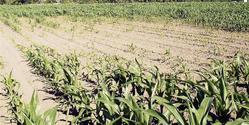
A section of a field infested with nematodes.
There has been a recent spate of talking in the print media about the lackluster performance of the agricultural sector due to soil disease. This is not a recent discussion but rather, has been in scientific and political circles as far back as 1958, with the publication of a study entitled Yeild Decline of Sugar cane on part of Worth Park Estate: Proceedings of the Jamaica Association of Sugar Technologists by R.F. Innes, P.D. Manser and G.F. Clarke. A further study was later published in 1966 by B.M. Hogg with the proceedings by the British West Indies Sugar Technologists.
These studies pointed to the fact that there are cyclical flare-ups that interfere with the natural production of plants attributed to a combination and increased population of non-competing species of nematodes, insects, fungi and bacteria - the chief culprit being nematodes.
Eight years ago in November 2000, Mark Brooks contacted CABI a bioscience technology firm in the United Kingdom, with samples of soil and root from under producing sugar cane fields, requesting an investigation. A visit soon followed by J.M. Walker to Jamaica for various sites followed up with discussions with several professionals in the field, including Dr Phyllis Coates-Beckford of the University of West Indies.
In his report, he found the level of production of the plant sites to be low and the roots of the plants at the sites diseased. Upon further investigation of the soil samples taken, there was found to be a high level of parasitic nematodes present.
Soil composition
The government then commissioned a sugar cane task force to investigate the soil composition of several sugar cane sites - the findings published and presented by Dave Hutton, a nematologist at the University of the West Indies.
His paper, Nematodes and Sugar Cane Production in Jamaica, points out the cyclical nature in which nematodes, together with certain fungi, have formed a complex, resulting in symptoms of root necrosis (the death of living cells or tissues) and loss and patchy reduction in stalk height and numbers leading to nutrient deficiency symptoms - this is what has been referred to as 'soil disease'.
The definition of the word 'disease', according to the Oxford Dictionary is "a disorder of structure or function in a human, animal or plant, especially one that produces specific symptoms". It seems that soil itself cannot be diseased given that it is not a living organism, rather, a medium; however, the symptoms displayed by the plants mimic those of actual diseases that can afflict plants, giving rise to the term and also outlining that correct diagnosis is difficult without some amount of investigation and assessment of the soil itself.
Worm
So what are nematodes, the chief culprit in all this damage and loss of crop productions? Simply put, it is a type of worm of the phylum Nemata or Nematoda. They are the most numerous multi-cellular organisms on Earth and a handful of soil will contain thousands of the microscopic worms, many of them parasites of insects, plants or animals.
Free-living species are abundant, including nematodes, that feed on bacteria, fungi and other nematodes, but there are thousands that are still unclassified. Nematodes have been characterised as a tube within a tube; referring to the alimentary canal which extends from the mouth on the anterior end, to the anus located near the tail. Nematodes possess digestive, nervous, excretory and reproductive systems, but lack a discrete circulatory or respiratory system. In size, they range from 0.3 mm to over eight metres. They are bilaterally symmetrical and usually tapered at both ends. Some species have separate sexes; others are hermaphroditic.
A variety of nematodes function at several trophic levels of the soil food web. Some feed on the plants and algae (first trophic level); others are grazers that feed on bacteria and fungi (second trophic level); and some feed on other nematodes (higher trophic levels).
Free-living nematodes can be divided into four broad groups based on their diet. Bacterial-feeders consume bacteria. Fungal-feeders feed by puncturing the cell wall of fungi and sucking out the internal contents. Predatory nematodes eat all types of nematodes and protozoa. They eat smaller organisms whole, or attach themselves to the cuticle of larger nematodes, scraping away until the prey's internal body parts can be extracted.
Omnivores eat a variety of organisms or may have a different diet at each life stage. Root-feeders are plant parasites, and thus, are not free-living in the soil. Those that are root feeders have several methods of feeding that can be classified into two groups: from the outside, or by embedding themselves just below the surface and feeding internally.
Nematodes can destroy an entire crop of plants of any type just by eating away at the roots, and in doing so, they basically diminish the production capacity of the plant, as well as the nutrient supply necessary for survival.
Solutions
There are some solutions that can be employed according to Mr Hutton which can include procedures such as applying nematicide to the soil as part of the soil preparation process before planting takes place.
Nematicides can be fumigant or non-fumigant; some known nematicides are Temik, Furadan and Mocap. There is also a natural nematicide that has been investigated by Dr Sylvia Mitchell with the use of neem fruit extract, which has shown to be very effective.
Crop rotation is also known to help in the population control since nematodes are also known to be plant specific in their feeding patterns. Anti-nematode crop integration in the crop, such has asparagus and certain species of marigold, have been known to act as a repellant for certain species nematodes.
Dry-running of the soil can be used in which the soil is left bare and dry for a long period of time, allowing the nematodes in the soil to die out from lack of food supply, and finally, of the introduction natural nematode predators, such as carnivorous fungi and predatory nematodes, that prey on other nematodes and smaller protozoa.
Strategic plan
Although these can be employed as a solution, this is only part of the solution to a persistent and prevalent problem. The use of fertiliser as a mask can no longer be used when the problem is not being addressed or solved. There needs to be a strategic plan developed for both the immediate and long term. One such case is a laboratory dedicated solely for the testing and identification of plant parasites, in underproducing crop sites.
There are educational workshops for farmers, and regular visits by specialists for any field that is showing signs of the disease or underproduction. The world on a whole is in short supply of a growing food demand. Trinidad has expanded their agricultural sites to accommodate the country's growth in demand for food, with Cuba following suit.
It is imperative that the issue of underproducing levels be investigated and addressed and that actions be taken to increase the supply of food without importation, to support the local agricultural sector.
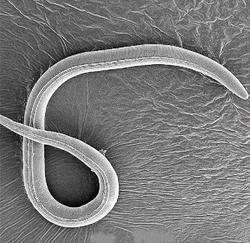
Root nematode: A microscopic plant-parasitic nematode
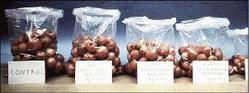
Production levels of onions for different quantities of nematodes in the soil. The least production is shown with the highest quantity of nematodes, while the control group has the highest level of production.
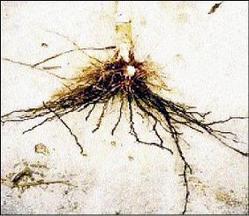
Sugar cane root disease symptoms.