Mark Titus, Enterprise Reporter
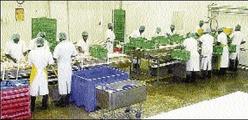
Employees at work in the state-of-the-art abattoir operated by Aquaculture Jamaica Ltd in Barton Isle, St Elizabeth. - Photo by Mark Titus
This is the final instalment in the riveting expose of the state of slaughterhouses in Jamaica.
After getting a douse of the horrific realities under which some of Jamaica's slaughterhouses operate, this reporter journeyed to St Elizabeth to get a first-hand view of the processing procedures at Aquaculture Jamaica Limited.
This facility, which is home to Best Dressed Fish, occupies 315 acres of property in the quiet community of Barton Isle and employs about 150 persons. Sixty per cent of the product is prepared for the international market, with 90 per cent of that amount going to the United Kingdom.
When The Gleaner arrived at the facility about 7:00 a.m., the place was abuzz with activity. I was handed a document which required my particulars and medical history. I was also required to sign an agreement to obey all safety rules while at the facility.
Farm Manager Lawrence Alexander served as my tour guide around the ponds, while explaining the meticulous processes observed in achieving quality.
At this point, Plant Manager Gary Walker took over and began to explain the process of food preparation.
I was taken to an area where the process to remove the blood from the fish begins. That procedure is completed by placing the fish in a bleeding tank, where they are kept for another 10 minutes.
Entering the abattoir, I was again required to read and sign another document, as well as remove my jewellery, watch and any other item that might be a potential hazard. The document further stated that hair and nail extensions were not allowed. I was clothed in a gown, while my head and shoes were also covered. Every worker was dressed similarly.
Intricate details

Levy
According to Stephen Levy, general manager of Aquaculture Jamaica Limited, every aspect of food preparation must be done with great care.
"Everything has to be documented, from how you feed the fish down to packaging, how your knives are sharpened to how they are stored, who stores them, what kind of chemical is used to clean them," he tells The Gleaner. "A whole range of hazard analysis is done to take care of anything that can compromise the quality of the item for consumption."
Apart from being recognised by the International Organisation of Standardisation, Levy says a lot of pressure comes from the veterinary services division of the Ministry of Agriculture, and with certification required every six months, the hazard analysis and critical control point standard must be maintained.
According to the GM, the local public health inspector plays a very vital role, "They are the ones who can make or break it. They play a very active role in our day-to-day operations and his synopsis is crucial to whether our product is exported or not."
Levy, however, says that the implementation and maintenance of such facilities in the public sector would require a high level of discipline from Government.
"To implement modern-day standards is very costly. To maintain these kinds of facilities costs even more; it would require a high level of discipline from the Government" Levy observes.
mark.titus@gleanerjm.com
The 'finished' product
From the bleeding tank, the fish are scaled, then graded with an electronic grader, and then they are fed through an evisceration machine. At that point, they are opened, vacuumed out; the heads are removed, washed, then weighed and sent to the filleters.
After this, the fish are again weighed and skinned, then weighed again, before going to the trimmers, who are responsible for removing the bones. The product is then sent to the deep skinners.
Then they are weighed another time, before being sent to the inspectors, who must ensure that the quality of the fish is up to par. If satisfied, the fish are sent to the spiral freezer.
From the spiral freezer, the product is sent to the packaging area, where it passes through a metal detector, after which it is again graded electronically, and then packaged according to the demand of the particular consumer for which it is intended. Through all this, Laurene Wedderburn, the quality assurance officer, must ensure that everything is done to the required specification.


















