Susan Gordon, Business Reporter
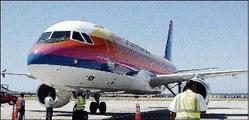
An Air Jamaica plane sits on the tarmac at the Norman Manley International Airport, Kingston.
The government says it is using the International Finance Centre, a World Bank subsidiary, to guide its planned privatisation of Air Jamaica because of the IFC's proven skill in such ventures - and its cheaper.
"Because of the uniqueness of an airline and the complexity of the operations, it is very important that those who are carrying out the actual work have airline expertise in the area they will be working," said Don Wehby, the minister in the finance ministry with portfolio responsibility for the airline.
Significantly, too, said Wehby, the IFC, the private sector arm of the World Bank, had helped the government to raise "a significant amount of grant funding" for the privatisation project.
The near 40-year-old Air Jamaica has been controlled by the government for most of its life, except for an 11-year period up to the end of 2005, when it was majority-owned by the AJAG Group, controlled by hotelier Gordon "Butch" Stewart.
But during its life the airline has never turned a profit, losing around a US$1 billion over the past dozen years. The government has budgeted a US$27 million grant for Air Jamaica this year, and will also have to take-up a significant chunck of the airline's debt-servicing costs.
Deep-pocketed partners
When Air Jamaica was re-nationalised after disagreements over who should cover the losses and how to recapitalise the airline, it was always the idea that the government would search for new, deep-pocketed private partners.
It was assumed that the project would have been undertaken, even with foreign assistance, by the Development Bank of Jamaica, which subsumed the National Investment Bank of Jamaica (NIBJ) which, through the 1980s, and up to recently, handled most of the government's privatisations. The DBJ is currently leading the divestment of the state-owned sugar factories and estates, which fall under the Sugar Company of Jamaica.
Instead, Wehby opted for the IFC.
"They have substantial expertise in advising on the divestment of airlines and have proven through discussions that the approach to be taken is sound," he said.
The IFC participated in the privatisation of state carriers such as Polynesian Airlines Polynesia, Air Tanzania, Kenya Airways, Air Vanuatu, Nigeria Airways, Air Lanka of Sri-Lanka, Affretair (cargo) of Zimbabwe, Wehby said.
Wehby said that the divestment team, including a project manager, is already in place for the Air Jamaica off-loading. This team will have oversight responsibility for the project, advising Wehby on the process.


















