Richard Deane, Business Reporter
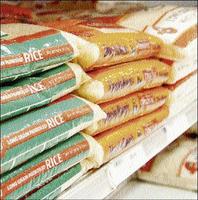
Stacks of packaged rice in a supermarket. - Rudolph Brown/Chief Photographer
Already hit by steep increases in basic food prices, it appears that consumers could be further burdened by a spike in the price of rice - a popular staple in the diets of Jamaicans.
The imminence of the price spike has emerged as Guyanese suppliers, who provide over 40 per cent of the rice consumed in Jamaica, have refused to lock themselves into the usual half-year contracts, raising fears among Kingston's importers of escalating prices during the current crop.
"There has been a change in the way that they have approached the issue of supply," said Bruno Loffler, the CEO of Jamaica Rice Milling, a major importer and miller of Guyanese rice. "In this current crop the Guyanese are only committing one shipment at a time."
In the past the trade would be based on six-month forward supply contracts,but with world market price for the commodity fluctuating in recent times, the Guyanese apparently want to keep their options open.
"They are watching to see what will happen," Loffler told Wednesday Business.
Jamaica and Guyana are members of the 15-nation Caribbean Community (CARICOM), a trade and political organisation that has been attempting to harmonise into a single market.
Strengths
The arrangement provides Guyanese growers with an advantage in the Jamaican market, but their situation is further strengthened by two factors: increasing Jamaican demand and the upward swing, globally, in food prices.
During the first 11 months of last year, for instance, Jamaica's rice imports jumped seven per cent, to 93,000 tonnes, driven in part by mid-year storms that damaged domestic agriculture. During the period supplies from Guyana increased by 13 per cent, to 41,500 tonnes, compared to the same period in 2006.
Yet, Guyana, with other markets beckoning its suppliers couldn't meet all of Jamaica's demands, helping to drive up prices here. The retail price of rice jumped over 50 per cent.
Increasing supplies

STERN
Towards the end of last year Jamaican importers had predicted that projections of a good spring rice crop would not only ease supplies, but also moderate prices.
But a global spiral in the cost of the commodity, helped by bad weather in Asia, where supplies from countries such as Cambodia and China, appears to be undermining such analyses.
In the circumstance, Jamaica is hoping to increase supplies from the United States, where costs have increased by about 27 per cent over last year - from $1,950 to $2,475 per 45kg bag. Loffler hopes that the US suppliers, most of whom are locked in six-month contracts, will meet up to half of Jamaica's demand.
In the case of Guyana, their price has jumped approximately 33 per cent over last year, but at the current $2,375 per 45kg bag, it is still a little over four per cent cheaper than American rice.
Michael Stern, Jamaica's junior trade and commerce minister said he was aware of the rice supply situation and the fact that the Asian shortage was competition for the output from Guyana and Caricom's rice producer, Suriname.
Last year CARICOM agreed to Jamaica's request for a relaxation of trade rules to allow the island to buy more rice from outside the community. Stern said that the Jamaican Government was watching the current Guyana harvest before coming to a decision on whether to make another such request.
"This can top up demand but we are hoping for a bumper crop," Stern said.
richard.deane@gleanerjm.com


















