
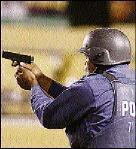
A policeman points his firearm in response to shots being fired at the Harbour View Mini Stadium last month. - Ricardo Makyn/Staff Photographer The Jamaica Constabulary Force (JCF) recently released a revised version of its Human Rights and Police Use of Force and Firearms Policy. Throughout this month, The Gleaner has been publishing excerpts of the document. This is the final publication of the excerpts.
Temporary Unfitness to Carry Firearms
The consumption of alcohol or the use of drugs in medical treatment or otherwise may reduce the alertness and performance of a member. Members of the JCF carrying firearms should not consume or be under the influence of alcohol. Any member who is receiving a course of drug treatment should seek the advice of their doctor concerning the possible side effects. Any concerns or medical advice given to a member should be brought to the attention of his/her immediate supervisor who should take appropriate action.
The Use of Firearms
When it is considered absolutely necessary to open fire on a subject, members of the JCF will only 'shoot to stop' and thereby neutralise the immediate threat.
Research has indicated that only shots hitting the central nervous system (which is largely located in the central body mass) are likely to be effective in achieving rapid incapacitation. Shots which strike other parts of the body cannot be depended upon to achieve this.
The accuracy of shots fired under training conditions is generally greater than in operational circumstances. Members of the JCF are therefore normally trained to fire at the largest part of the target they can see which in most cases will be the central body mass.
Members should constantly reassess the need for any further action, using no more force than is absolutely necessary and relative to the threat posed.
The ultimate responsibility for firing a weapon rests with the individual member, who is answerable ultimately to the law in the courts. Individual members are accountable and responsible for all rounds they fire and must be in a position to justify them in the light of their legal responsibilities and powers.
Any discharge of a firearm, other than in training whether intentional or otherwise must be reported by the member concerned.
Warning Shots
Police should not fire warning shots. There are serious risks associated with the firing of such shots, which have the potential to cause unintentional death or injury. They may also lead a subject or other officer to believe that they are under fire.
An officer will only be justified in resorting to the discharge of a warning shot(s) in the most serious and exceptional of circumstances where failure to do so would result in the loss of life or serious injury. Members of the JCF who discharge a firearm under any circumstances must give full consideration to public safety.
Reporting and Review Procedures
In cases of death and serious injury or other grave consequences, a detailed report shall be sent promptly to the competent authorities responsible for administrative review and judicial control.
Persons affected by the use of force and firearms or their legal representatives shall have access to an independent process, including a judicial process. In the event of the death of such persons, this provision shall apply to their dependents accordingly.
Governments and law enforcement agencies shall ensure that superior officers are held responsible if they know or should have known that law enforcement officials under their command are resorting or have resorted to the unlawful use of force and firearms and they did not take all measures in their power to prevent , suppress or report such use.
Obedience to superior orders shall be no defence if law enforcement officials knew that an order to use force and firearms resulting in the death or serious injury of a person was manifestly unlawful and had a reasonable opportunity to refuse to follow it. In any case, responsibility also rests on the superiors who gave the unlawful orders.


















