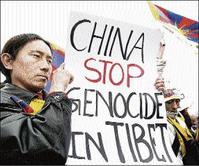
A protester holds a poster reading 'China stop genocide in Tibet' during a demonstration against a crackdown on protesters in Tibet, in front of the Chinese embassy in Berlin on Monday. The tough tactics of Chinese police in crushing protests have sparked rage worldwide, with the Dalai Lama - Tibet's spiritual leader - calling the action tantamount to "cultural genocide". - AP
NEW YORK (AP):
United Nations leaders said Monday they saw little reason so far for the United Nations to wade into the dispute over China's crackdown on protesters in Tibet, despite the Dalai Lama's call for an international inquiry led by the body.
No one raised the issue Monday at a Security Council meeting and lunch with Secretary General Ban Ki-moon.
Afterward, however, Ban urged Chinese authorities to exercise "restraint" in Tibet - his strongest message on the violence to date - and did not rule out a future UN role.
The attitudes of UN leaders range from deepening concern to complete disregard of the crackdown on protesting Buddhist monks and other Tibetan activists. The views an unspoken acknowledgment of China's status as one of the council's five veto-wielding members and an emerging world superpower playing host to the summer Olympic games in Beijing.
Call for a probe
The Dalai Lama harshly condemned China on Sunday as waging "cultural genocide" against his Tibetan followers. The spiritual leader of Tibetan Buddhism, who is the head of the Tibetan government in exile from Dharamsala, India, has called for a UN-led international probe into the uprisings.
On Monday, Ban called for both sides to make peace.
"I'm increasingly concerned about the tensions and reports of violence and loss of life in Tibet and elsewhere. At this time I urge restraint on the part of the authorities, and call on all concerned to avoid further confrontation and violence. And I stress the importance of a peaceful resolution," he told reporters outside the council's chambers.
Asked whether he sees a UN role toward Tibet, Ban answered, "We will continuously monitor the situation; we'll get back to you."
This month's council president, Russia's UN Ambassador Vitaly Churkin, told reporters that Russia's view was that "it's clearly not a matter for the Security Council, or for the United Nations."