Wilberne Persaud, Financial Gleaner Columnist

Persaud
Universities across the world today face conditions entirely unknown to faculty and administrators a mere decade ago.
Ivory Tower days are over; not only here, everywhere.
Communities, governments, politicians, parents, students are all becoming more critical, vocal, even strident, about universities' policies.
For US universities - world leaders by so many metrics - expert opinion views the situation as grave.
The University of the West Indies (UWI) students' article, which led me to comment on this issue in the first place, highlighted transforming the look of the Mona campus for transformation's sake - a dispensation of immediacy.
It argued that "the university neglects to invest in areas that would improve the required image (in terms of international recognition, not visual recognition), such as research and research students."
But UWI has an agenda for strategic change created after considerable consultation and research into relevant demographics and conditions our region shall encounter.
In the current environment of multiple universities, some perhaps not worthy of the name, UWI must obviously, engage its constituents. In great measure it has. But there are a few issues in the way its constituents are engaged that might bear discussion.
PUBLIC RELATIONS VS PUBLIC DIPLOMACY
What goes on within any university still retains its mystery for many.
Image building is necessary. Whereas visual recognition is immediate, impact of public diplomacy requires time.
Public diplomacy in the sense I imply, not its international relations aspect, refers to a seeming contradiction: truthful propaganda. It is like blowing your own trumpet, albeit truthfully, in a way that is not obnoxious. We are all aware of the contempt the term PR evokes - 'Oh that is just PR' - literally stuff not to be believed. If, therefore, we agree UWI needs public diplomacy but its execution is confused with and entrusted to public relations practitioners as opposed to being guided by scholars with a grasp of the role of academic freedom, duty and responsibility, institutional memory and so on, there is an ever-present danger and likelihood that hype shall prevail over tasteful, comprehensible public display of substance.
The purely public relations angle leads to a focus on short-term ad hoc activities emphasising immediate physical, showpiece projects that take on cliché names, such as 'rebranding' with insufficient analysis of meaning.
Effective public diplomacy, on the other hand, would highlight simply, in comprehensible ways, the true wealth of the institution - its knowledge base.
These could take the form, to name but a few, of exhibitions that travel the country exposing the young, the old, the rich and poor to the work the institution undertakes. Teams of students could be chosen to spend periods of their study in attachments across the country doing good educational deeds.
As a former colleague of mine noted, why have not the math and science areas, linguistics, et cetera, adopted the Mona High School next door and raised its CXC passes through the roof? This would be tangible - with attached bragging rights - public diplomacy for the university in practice. These kinds of activities cost money but their returns are incalculable.
SOCIETY'S IMMEDIATE NEEDS
Undoubtedly, Mona must provide for Jamaica's needs.
The postgraduate students appear to be of the view that these are being defined purely as the immediate filling of positions generated by requirements of business and current economic activity.
If they were correct, it would mean the bigger picture is obliterated. Student numbers will increase without commensurate resource capabilities. There is a hint of disdain, almost contempt in their referral to the MBA as 'famous'. This perception is misplaced.
Creating the MBA programme was essential and Mona has an impressive business school partly funded by Jamaica's private sector. Little new knowledge is generated here though. The cohort is taught various skills useful and necessary for the business world. This is very important and undeniably a part of the university's focus.
One need merely consider the array of offerings locally available to recognise that UWI would have been short-sighted in dereliction of duty, had it not done so, not to mention that the quality of some of the competition is an unknown.
But it must be the duty of UWI to improve other areas of capability as the MBA flourishes. Cross subsidy is necessary.
THE ENTREPRENEURIAL UNIVERSITY
What of income generation and capacity building in face of little cash and insignificant endowment? This is an enormous problem. How can UWI adapt without sacrifice of standards and requisite improvement?
Historically, UCWI and early UWI relied on government funding.
Our late Nobel Prize-winning principal and economist Sir Arthur Lewis allegedly once spent two lonely entirely sleepless nights putting together financial proposals that governments of the then UCWI could support. It always was negotiation to the brink, a situation that could not continue.
Indeed, Lewis' memorandum to the Conference on Common Services of 1962 is still useful on these issues.
More recently, fund-raising, alumni support and other efforts garner resources.
Here is our most important issue: creating the requisite capital resources for the institution.
On the Mona campus, a business development office was created. It sought among other things to introduce projects with an income generating capacity.
Under its wing came projects like the Mona Visitors' Lodge and initiatives that brought private businesses to undertake provision of services for students. Each of these is a profit centre. But in the scheme of things, their contribution is minuscule compared to what is possible.
Furthermore, they suffer from highly intensive use of limited resources.
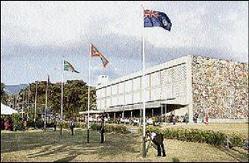
The grounds of the University of the West Indies, Mona, St Andrew.
Just as US universities developed mechanisms to transform and develop knowledge for useful and lucrative economic activity, in a sense to monetise knowledge intensity, so too must our universities create the kinds of functioning units within its walls and the kinds of partnerships with society at large, that accomplish this.
A university is an unbelievably complex organisation that is said to change glacially.
For any new endeavour, it may well be difficult in our environment to convince people of viability. But nothing beats even one successful attempt.
A university business and technology park, a unit specifically tasked to explore commercial possibilities of knowledge of properties of endemic plants and bases of folk remedies for instance, potential for health foods and tonics, provision of alternative energy sources, explorations of the digital business model, an environmentally friendly campus transit system, sports, marketing exploitation of Jamaica's acknowledged perhaps unique athletic prowess - just to name a few.
Here's the complexity: each of these potentials requires significant interdisciplinary focus, a capital budget, financial management, public diplomacy, and the list can go on.
So what is it that hampers, going beyond merely their stipend, the goals identified in the university's strategic planning and, indeed, implied by our postgraduates' yearning?
Evolution
For centuries universities were institutions for cultural conservation and transmission. They evolved with creation of new knowledge. United States universities, in particular, moved the goal posts entirely to include capitalising knowledge.
It is this focus that distinguishes the entrepreneurial university. It evolves not by the private thoughts and musings of its faculty and leaders, but because of changing environments in which the institution must function.
Given the nature of some of the activities and initiatives we have mentioned, preparatory work for implementation must be accomplished almost in clouds of secrecy. So these comments may be entirely superfluous and unnecessary.
For the entrepreneurial university, the possibilities are truly endless.
wilbe65@yahoo.com