Tennesia Malcolm, Gleaner Writer
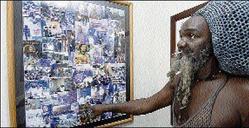
Benji of the Trench Town Culture Yard guides visitors through a collage at the tenement where Bob Marley once lived. - Photos by ian allen/staff photographer
ALTHOUGH he was born in rural Nine Miles, St Ann, it is with Trench Town, an inner-city slum beset by poverty and violence, that Bob Marley is most associated. It was there that a youthful Marley began a music career which was to propel him to superstardom.
So, why is it that decades later, most are willing to appreciate this community from a distance - through photographs, newspaper articles and second-hand accounts from those brave enough to tread?
"We've had moderate support from mostly community-based people," said Zebilon, a Rastafarian based at Culture Yard, the tenement on First Street where Marley resided and wrote many of his lyrics. This was his response to a query about support for the annual celebrations held in Trench Town on February 6, Marley's birthday.
Benji, another Rasta who says he lived in the immortalised 'government yard' with Marley, expounds. "Stress breeds crime; some bear it, some don't," is his explanation for the persistent crime which has kept many away.
Crime factor
Benji admits that crime was a factor in the early days, influencing some of Marley's songs like Rat Race, but that was of a purely political nature. Since then, crime has taken on an uglier face, with political tension taking a backseat to reprisal killings. To complicate issues, the singers and players of instruments have seemingly gone away.
"Things have changed a lot; it used to be more cultural and the musicians are not around to that," said Benji.
The Trench Town Culture Yard was launched on February 6, 2000, as homage to the yard where Marley was inspired to write many of his legendary songs. Marley's room and the shell of the Volks Wagen van he once owned are still there, but commercial success has eluded the location.
When The Gleaner visited Culture Yard on Ash Wednesday, there was no live music, just the familiar sounds of Marley's songs blaring through speakers.
Zebilon explained that there was a three-day celebration lined up, culminating in a live stage show on Friday, February 8. Benji pointed out that the initiative is supported by the Marley family. He said that sponsorship over the years had slowed to a trickle as unscrupulous individuals would collect money that never made it to the Culture Yard coffers.
"We had to move them up because them don't give us no justice," says Benji. An irony, since justice was something the reggae king strongly advocated.
On Ash Wednesday, Culture Yard was slowly becoming abuzz with youngsters who said they identify with Marley's teachings but not necessarily his choice of hairstyle.
Public holiday
Omar, 29, sported neatly braided hair and substantial sized stud arrings. "You don't have to have the locks on your head to be a Rasta," he said.
He is generous in his praise for Marley, saying, "If a neva Bob Marley, you wouldn't know 'bout Trench Town". Omar believes Marley's birthday should be made a public holiday.
That Marley is so embraced by youth around the world means he remains relevant, and his roots remain relevant. The face of Culture Yard has changed with visitors (including Britain's Prince Charles) no longer being only Rastas. Now, those caught up with the fashion of today - massive ear studs and bleaching cream - present a jarring contradiction.
But, even with this evolving reality, the yard's biggest demon is crime which dominates the Trench Town landscape and keeps would-be visitors away.
The community got a booster shot last Friday when a live concert, featuring Stephen and Damian 'Jr Gong' Marley, was staged at nearby Vin Lawrence Park.
Also making a rare appearance was Bunny Wailer, the only surviving member of the classic Wailers line-up.
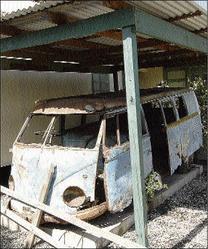
The shell of the Volks Wagen vehicle once owned by Bob Marley.
Trench Town notes
Trench Town inspired many Marley songs including Trenchtown Rock, No Woman No Cry, Concrete Jungle and Natty Dread.
Marley remained close friends with his Trench Town brethren. They included Georgie (whom he paid tribute to in No Woman No Cry); Vincent 'Tata' Ford (credited as co-writer of No Woman No Cry); and Seeco Patterson who played percussion with The Wailers.
Marley moved his family to the Rastafarian commune of Bull Bay after he left Trench Town.
The Wailers were one of several vocal groups out of Trench Town to make a musical mark. Others include The Heptones and The Abyssinians.
Trench Town is located in the St Andrew South police division, one of the most violent in Jamaica.
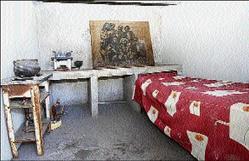
The room where Bob Marley lived at First Street In Trench Town.


















