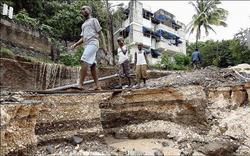
Camp View Avenue in Kintyre, St Andrew, has been severely eroded by flood waters, forcing residents to use a makeshift bridge to get from one side of the road to the next. - Ian Allen/Staff Photographer
The following is a summary, by Gerald Lalor of the International Centre for Environmental and Nuclear Sciences, of a report on the link between lead and violent behaviour.
Shakespeare's Hamlet may well have considered the following quote by Fairfax County economist Rick Nevin an understatement: "The idea that a society could have systematically poisoned its youngest children with the same neurotoxin in two different ways over the same century is almost impossible to believe."
Nevin's work, published in volumes 83 and 104 of Environmental Research, when combined with the body of knowledge collected over the last half century, suggests that society has done just that by the use of lead in paint and gasolene.
The abstract of the later paper reads: "This study shows a very strong association between preschool blood lead and subsequent crime rates over several decades in the USA, Britain, Canada, France, Australia, Finland, Italy, West Germany and New Zealand. The relationship is characterised by best fit lags (highest R2 and t-value for blood lead), consistent with neurobehavioural damage in the first year of life and the peak of offending for index crime, burglary and violent crime. The impact of blood lead is also evident in age-specific arrests and incarceration trends. Regression analysis of average 1985-1994 murder rates across US cities suggests that murder could be especially associated with more severe cases of childhood lead poisoning."
Supporting work reported
As often happens, a somewhat similar and supporting work was also recently reported independently by Jessica Reyes from Amherst College, curiously also an economist. Both find that the reduction in childhood lead exposure in the late 1970s and 1980s was responsible for very significant declines in violent crime in the 1990s and expect further declines in the future.
Towards the end of the 1980s, trends and projections showed substantial increases in the incidence of crime for the 1990s, but surprisingly in the United States, violent crime rates fell remarkably. In New York, the murder rate peaked in 1990 at 9.5 per 100,000 and then fell to 6.3, a difference of 9,616 persons from 1993 to 1998, and several other cities reported similarly.
As criminologists Alfred Blumstein of Carnegie Mellon University and Richard Rosenfeld of the University of Missouri-St Louis noted, two-thirds of the total decline in the number of homicide arrests in the US between 1993 and 1997 was due to a fall in the number of crimes attributed to youth. Other countries, though unfortunately not Jamaica, had similar experiences.
The numerous theories to explain the changed trends included the booming economy, the passing of the baby boom, reduction in the market for crack cocaine, increased incarcerations, more effective policing, tighter gun control legislation, the passage of abortion laws in 1973 (which supposedly led to fewer unwanted children and better childcare). Some politicians and police forces claimed credit (and still do), but the only general consensus of the experts is the trite one, that the reduction was due to a large number of complex contributions and interactions of policies, demography, economics and actions. No single theory came near to explaining the picture until the accusation that lead, first in paint and then in gasolene, was the major factor.
Toxic killing
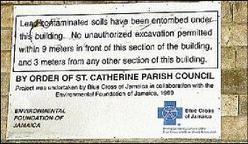
An order by the local council warning of lead-contaminated areas in Red Pond, St Catherine, is seen in this 2004 Gleaner file photo. - photos by Andrew Smith/Photography Editor
Even in antiquity, lead was known to be toxic enough to kill, but only in the last half of the 20th century, due largely as a result of work done in the US, was it recognised as a global environmental pollutant and an effective neurotoxin even at low exposures.
This led to a remarkable lowering of the acceptable blood lead levels for children from 50 microgrammes per decilitre (g/dL) and recommendations such as those of the United States Centers for Disease Control and Prevention, shown in Table 1, were developed and applied.
These recommendations are also used in Jamaica, but there is a growing view that no concentration of lead is really safe for children. It was also well appreciated that the two major sources of widespread childhood exposure were lead in paint and the lead tetraethyl gasolene additive that helped establish the modern high compression automobile engine.
The enormous post-World War II use of leaded gasolene made lead poisoning common. The problem was especially severe for inner-city children who were breathing lead-laced auto exhaust, and also living in older housing contaminated with lead paint. Starting in the US, the elimination of lead from gasolene and paint, and other actions including the reduction of lead emissions from municipal incinerators, reduced the environmental concentrations starting in the 1970s. At that time, black two-year-olds in New York City and Chicago had average blood lead levels over 30 g/dL. Between 1970 and 1974, the number of New York children heavily poisoned by lead fell by more than 80 per cent and has continued downwards. Today, the US average blood level is about 3.2g/dL. A recent Jamaican islandwide average was found to be 7.3 g/dL.
Numerous previous studies have confirmed the extent of lead poisoning worldwide, the neurotoxicity of lead, its lowering of IQ values, the increased risk of severe learning disabilities and impulsive sometimes violent behaviour, and contributions to increased crime rates in juveniles and adults. It was after all such work that demonstrated the dangers of chronic lead exposures and convinced governments to restrict the use of this very important material ironically the removal of lead from gasolene was first done because it poisoned the catalytic converters needed to meet new emission controls. This earlier work provided a logical core for Nevin's and Reyes' analyses of crime rates and lead poisoning.
The United States data show two lead-poisoning spikes: the earlier Nevin links to lead in household paint which was outlawed in 1978, the later post-World War II, they both attribute to the great increase in the use of leaded gasolene which was gradually phased out in the US during the 1970s and '80s. These blood lead and crime incidence data rise and fall together and there is a very strong association between preschool blood lead and subsequent crime rate trends over several decades, not only for the US but also for Britain, France, Australia, Finland, Italy, West Germany and New Zealand, where the decisions on lead removal came somewhat later and other conditions might reasonably differ.
Regression analysis
Nevin's regression analysis with a time lag of 23 years suggests that murder could be especially associated with early severe cases of damage from lead poisoning in the first year of life, a time at which the developing brain is known to be extremely sensitive to lead.
The surprisingly large magnitude of the lead/crime association indicates that the removal of lead accounts for some 65-90 per cent of the variation in violent crime rates, in the US and in many countries. If this is so, the enactment of the US Clean Air Act has done more to reduce crime than any other contributing entity. In science, however, the more confirmations the better, and because many other countries, eg Jamaica, Indonesia, Venezuela and sub-Saharan Africa, banned tetraethyl lead later that the US, and some others - Afghanistan, Serbia and Iraq, and much of North Africa and Central Asia - still continue its use, there is an interesting opportunity to confirm the global effects of lead usage on human society.
Jamaica
For several decades Jamaican children have been exposed to lead, mainly from mine waste in the Kintyre region, lead recovery mainly located in the Red Pond area of Spanish Town and scattered illegal backyard smelting operations mainly in Kingston, St Andrew and St Catherine, leaded gasolene wherever cars operated and lead-containing household paints.
Some results of the most recent survey by ICENS indicate significant improvement in blood lead levels (The First National Report on Chemicals in the Jamaican Environment: Lead) and are summarised in Table 2.
These results show improvement over previous ones but as many as 16 per cent of the sample still have lead levels of concern. Some children have had so much and consequent storage in the bones that even after several chelations, the high blood levels return time and again. Because of the lag period, the societal costs of lead exposure are still with us and may include a contribution to our high murder rate. It could be argued perhaps that this is now mainly history, but it would be valuable to better understand these effects of lead in follow-up studies on persons who spent their early childhood in lead-contaminated areas like Kintyre and Red Pond, and those incarcerated for violent crimes.
In any event, the potential damage of lead seems to increase with each discovery made, so for the future, lead exposure for children should be kept to an absolute minimum and those previously affected require continuing medical attention for a long time.
Much progress has been made in restricting the amount of lead in the Jamaican environment: The sources of poisoning in the Kintyre and other areas have been isolated, the lead recovery plant closed, backyard smelting has been greatly reduced, lead in household paint discontinued. Leaded gasolene was banned by the Government in 2000, and toy imports are checked for toxic levels. But the continuing warnings provided by worldwide studies on lead toxicity should maintain a sense of urgency in protecting our children. And it should be remembered that the greatest risk of lead poisoning in Jamaica is now the improper disposal of lead-acid batteries.
Acknowledgements
Major funding for research on lead by ICENS was provided by the Environmental Foundation of Jamaica and the CHASE Fund.
Table 1. CDC guidelines for lead poisoning management
Class Blood Leadmg dL-1 Recommendation
I < 9 Not considered lead poisoned.
IIA 10 - 14 Prevention activities and more frequent screening.
IIB 15 - 19 Nutritional and educational interventions and more frequent screening. If the blood levels persist, environmental investigation and intervention should be done.
III 20 - 44 Environmental evaluation, remediation and medical evaluation. Pharmacological treatment of lead poisoning may be needed.
IV 45 - 69 Medical and environmental interventions, including chelation therapy.
V > 70 Medical emergency. Medical and environmental smanagement must begin immediately.
Table 2. Summary of the blood lead levels (mg/dL) by CDC classification groups and parish
| No of Children | Range | Mean | <10 | 10 -19 | 20-44 | 45-69 | >70 |
| KSAC | 337 | 1.4-202 | 13.0 | 228 | 51 | 43 | 9 | 6 |
| St Cath. | 204 | 1.4-61.9 | 8.0 | 163 | 28 | 9 | 4 | 0 |
| Island | 1081 | 1.4-202 | 7.3 | 908 | 93 | 61 | 13 | 6 |
|
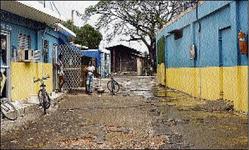
Youths loiter outside shops along a street in Red Pond, one of several Jamaican communities which has a history of lead contamination. Studies have shown a link between lead contamination and a propensity to violence.


















