Shelly-Ann Thompson, Staff Reporter
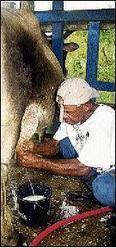
Dairy farmer Lloyd Bernard of Braes River, St Elizabeth, milking a cow on his farm recently. - File
Up to five years ago, some 5,000 litres of fresh milk was being dumped daily. Today there is a shortage of the calcium-rich liquid and now the Ministry of Agriculture is proposing to import cows in a bid to avert a nutritional crisis.
This is among several proposals contained in a draft document for submission to Cabinet by mid-March.The draft comes amid a noticeable absence of milk from supermarket shelves across the island. There have also been reports of a shortage of milk powder in the country.Local production of fresh milk has been on the decline since the early 1990s. Some 14 million litres of fresh milk were produced last year, significantly less than the 140 million litres consumed annually.
Restoration
Agriculture Minister, Dr Christopher Tufton, told The Gleaner that the Government is committed to increasing the production of milk and restoring the local dairy industry.He said strategies would be developed to address the current shortage after meeting with stakeholders in the sector."It (dairy industry) was a subject of discussion at our Cabinet retreat and discussed at length within the ministry," said Dr Tufton.The multi-pronged approach under contemplation by his ministry includes increasing the dairy stock, which Dr Tufton said "has been steadily declining".He added: "We would bring cows into Jamaica which would be done with the necessary quarantine and requirements."Dr Paul Jennings, chief executive officer of the Dairy Development Board, revealed that the Jersey cows were among those being considered for importation.A proposal to expand the dairy herd, specifically the Jamaica Hope breed developed by the late Dr T.P. Lecky, has been included in the draft submission."These strategies are essentially looking at where we can also triple the current level of milk production within five years," explained Dr Jennings.Regarding an embryo transplant programme, which is basically transferring fertilised eggs from one cow to a surrogate, the ministry is contemplating adopting procedures similar to New Zealand, given the issues with the outbreak of mad cow disease in the US."Our animals are producing below potential," he said.Another strategy being con-sidered, said Dr Jennings, is a loan programme to assist farmers to improve pastures nationwide."Right away we would want to start the pasture management programme as many of our pastures are run-down," he said.All these strategies are tied to a policy programme for the training of staff and continuous research to improve milk production.But while the ministry is completing its Cabinet submission, stakeholders in the industry are blaming the Government for the current demise of the dairy industry.
Liberalisation woes
They contended that the liberalisation of milk powder imports from Europe and the United States led to significant problems for local dairy farmers.Raymond Brooks, the immediate past president of the Jamaica Dairy Farmers Federation, explained that they could not compete as milk powder was cheaper than fresh milk."Several litres of milk had to be dumped on a daily basis as there was no market," recalled Brooks.Paul Ying of Y's Choice Wholesale in Cross Roads, Kingston, said his last supply of milk powder was about three weeks ago."It's been a while, the distributors say it scarce. It is mainly the soy milk we getting," said Ying.Brooks explained that the shortage has stemmed from strong demands in China, resulting in the supplies that are normally shipped to Jamaica going to the Asian powerhouse.Brooks has, however, welcomed some of the strategies being proposed by the ministry, including establishing facilities for embryo transplant.He said the art of embryo transplant has been perfected elsewhere "and I don't see why it couldn't work out here. Is just that we are just backward out here".
shelly-ann.thompson@gleanerjm.com