Paul H. Williams, Sunday Gleaner Writer
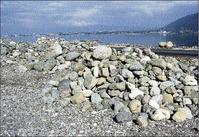
Piles of huge boulders, yet to be used, have been unloaded along the strip since the passage of Hurricane Dean. - Photo by Paul Williams
From the Kingston waterfront, it is a long strip of land that frames the harbour perfectly. From high-rise buildings, it looks idyllic, almost enchanting. So you journey there to wallow in its magic. But when you reach Harbour View and enter the strip, you realise its beauty is an illusion. This narrow sandbar, called a tombolo, which connects Port Royal to mainland Kingston, is in fact, under serious threat of erosion, flooding and disappearance. The ravages of man and nature are evident everywhere. Simply put, The Palisadoes is in peril.Vegetation was removed
The Palisadoes was once covered with mangroves, whose intricate root systems help to keep the sandy soil together. To build roads, and for other social reasons, the mangroves and other vegetation were removed over time, exposing the coastline and the land to the full forces of nature. The Kingston Harbour side of the road is now being slowly eroded by the sea, and the southern side is being washed away fast by rough waters. A reef, near the strip, that used to break the force of the waves, was destroyed, putting the fragile deposits of earth, sand and stones under constant threat of degradation.The critical state of this natural formation is the source of anxiety and discontent for many stakeholders. The strip is the only land route for Port Royal residents to and from Kingston, and is the home of one of two international airports on the island. Recent flooding of some sections of The Palisadoes road speaks loud and clear of the need to render intensive care to this vital promontory.In an effort to resuscitate the growth of mangroves on The Palisadoes, The Port Royal Marine Laboratory (PRML), operated by the University of the West Indies, in collaboration with the National Environment and Planning Agency (NEPA), planted a variety of 600 mangrove trees on the Kingston Harbour side. This was in commemoration of World Wetlands Day, on Saturday, February 2.In rationalising the activity, Camilo Trench, chief scientific officer at PRML says: "Replanting mangroves on World Wetlands Day is an attempt to take another step in the right direction, as head-starting these rooted seedlings gives them a better chance of survival thus stabilising the sand. This one-day planting promises to be the start of a good habit in the Palisadoes Port Royal area, and hopefully, in the rest of Jamaica's many other coastal regions needing such attention."Massive deposits of garbage
The torpedo-like seedlings, called propagules, usually grow naturally after they fall from the trees. But because of the interference of man, and the massive deposits of garbage in some sections of the protected mangrove region, several of the propagules do not survive when they fall to the ground. Thus, many of them are picked from the trees, grown under controlled conditions, and planted in areas where they are needed."This is supported by NEPA's efforts to encourage seagrass and mangrove replanting in issuing permits and licences to coastal developers (hotels, marinas, etc). This is a sound environmental step by our Government's environmental agency. (However), re-vegetating the area will be difficult due to tidal factors, the possibility of hurricanes, and of course, cost," Trench says further.Personnel from NEPA and PRML, students from Port Royal All-Age School and The Queen's School's Science and Technology Club, among others, participated in the project, which is expected to continue. It was a valiant effort to restore and preserve a piece to land that is very important to the country in many respects.paul.williams@gleanerjm.com


















