Mario James, Gleaner Writer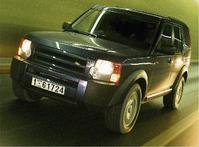
The all-new Land Rover Discovery 3.
Last November, for the first time in its 59-year history, Land Rover drove through the 200,000 sales barrier. Its global sales reached 205,717, or 27 per cent ahead of the same month last year, putting the company on course for its third successive record sales year.
"This is a significant milestone in Land Rover's history and puts us on a firm footing as the marque approaches its 60th anniversary. Our sales achievement has been driven by exciting new products with improved environmental performance. Confidence is high - Land Rover is firmly in the black with our revamped product line that will continue to be prized highly by our target market," said KIG's sales and marketing manager, Kent LaCroix.
Range Rover, powered by a diesel V8 that delivers a 32 per cent fuel improvement on the petrol version it replaced (it is installed in the compact Freelander II as well), has driven sales across the world. The success of Land Rover's models peaked with even more awards for the Discovery 3, delivered by the British magazine Planet 4x4. Range Rover was voted overall runner-up - just 4.1 per cent behind the Discovery 3, and Range Rover Sport and Freelander 2 both scooping class wins.
Testers wowed
"With the top three overall places in 2006 and a clean sweep of class awards this year, Land Rover is getting it right at just about every level. One tester after another was wowed by the Range Rover's class, the Sport's style and the Discovery's practicality," said Alan Kidd, editor of Planet 4x4 magazine.
"But what I think Land Rover can be particularly proud of is that this result comes in a competition where scores for off-roading meant almost nothing - and value for money counted towards almost a quarter of the total mark. It would be easy to write this off as a series of victories for the most expensive machines ... but, in reality, it shows that with Land Rover, you really do get what you pay for," he concluded.
Not one to rest on its laurels, Land Rover has developed a new concept vehicle that is based on trends they feel that this new buyer wants. Called the LRX, is not slated for immediate production. But it is quite a departure from LR's traditional boxy styling cues. It has put a wheel at each corner of the chassis, still retains traditional touches but has applied these appliqués in a way like never before.
Where the old template woos you with old-world civility and charm, this new concept hits you in the face with modernity. It is real swoopy. As the company prepares to celebrate its 60th anniversary during 2008, the three-door LRX, with its more compact size, lighter weight and sustainability-focused technologies, clearly addresses the needs of a changing world.
LRX is described as a cross-coupe and dramatically extends the scope of what Land Rover represents. Though 149 mm (5.9 in) shorter than the Freelander 2/LR2 and 205 mm (8.1 in) lower, LRX was conceived as a premium car, designed to appeal to new customers in the luxury and executive sector - those who want many of the benefits of a 4x4 and the presence of a larger vehicle, but in a more compact package.
The first all-new Land Rover revealed since Gerry McGovern became the company's design director, LRX is a natural extension of the Land Rover range, complementing the existing models and helping to define a new segment. LRX is conceived as a highly fuel-efficient, 2.0-litre, turbo-diesel hybrid, capable of running on bio-diesel. The concept's integrated electric rear axle drive (ERAD) is particularly significant in Land Rover terms as it would allow LRX to use electric drive alone at lower speeds while retaining full 4x4 ability.
Additional torque
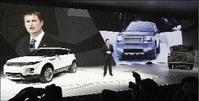
Phil Popham, managing director, unveils the hybrid LRX concept vehicle at the 2008 North American International Auto Show.
ERAD provides additional torque only when it is needed, and with maximum electrical torque from standstill, this solution offers even better low-speed control and enhanced pull-away on difficult surfaces. Also, the system allows low-speed traffic creep up to 20 mph (32 km/h) on electric power alone, with the Integrated Starter-Generator (ISG) function restarting the engine automatically when needed. It stops the engine automatically when the vehicle halts in traffic, so the engine does not idle needlessly, and restarts it quickly and smoothly as required.
Hill Descent Control and Land Rover's acclaimed and user-friendly Terrain Response system is also included in the concept. On LRX, this has five modes, including the new and efficiency-focused 'Eco' mode. Principally for on-road use, this configures all the integrated elements of the car's system for optimised fuel economy. The other four Terrain Response modes provided are sports (also new), general driving, sand and a 'grass/gravel/snow' mode.
Airy feeling
The design's clever use of space gives the car an airy feeling, even though the car is smaller than the current model. On either side of the horizontally split, power-operated tailgate, removable and power-adjustable speakers include an iPod docking station. Various refrigerated compartments abound, and the tailgate also has integral aluminium cupholders between two padded seating areas. The clear roof is supported by a 'spider' frame running into the A-pillars.
With the rear seats folded forward, two mountain bikes can be fitted upright behind them, with front wheels removed and stored in dedicated slots in the floor. The interior also has multiple tie-down options and a through-loading option.
"We are determined to make sustainability a key element in our future product design and the way we do business," said Phil Popham, Land Rover's managing director. "No single technology delivers all the answers to whole-life sustainability, but the LRX concept brings together some of the ideas for the future that interest us, integrating them into a car that we believe represents an exciting way forward for Land Rover."
mario.james@gleanerjm.com


















