Paul Messam, Gleaner Writer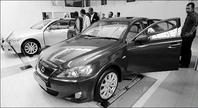
Potential buyers examine Lexus cars.
Modern vehicles boast elegance and subtle sophistication in their craftsmanship. Just look at the dashboard of a late model vehicle, and you'll be amazed at the type of technology that takes automotive intelligence to a new level. In order to fully understand and control the motor vehicle, we need to be aware of the location and functions of these sophisticated switches and built-in controls.
"When a driver slips behind the wheel of a motor vehicle, he should, in a certain sense, become part of the machine," says Anthony Brown, an experienced auto mechanic. "We sometimes tend to oversimplify the driving task, interpreting the role of the driver as one involving elementary movements of ignition switch, throttle, steering wheel, pedals and others," he adds. He further explains that what is generally ignored is that there is a right and wrong way to make these movements, and that the incorrect manipulation of these controls can have a deciding effect on one's driving.
Like a pilot, a driver should be 'checked out' with his motor vehicle before he hits the road. A defensive driver is aware of the location and the manner of operation of all the instruments in the vehicle he is driving.
Risky
"Time spent looking for a dial or a button means time spent with those valuable eyes off the road, and that could spell disaster in the wink of an eye," Brown comments. When a safe driver prepares for take off, he runs through a list of the required operations and controls: turning knobs, flicking switches in an orderly sequence. Once the engine is running, the ammeter and oil pressure gauges or warning lights should be checked to ensure that no malfunction exists. We shall mention a few for your information, bearing in mind that controls and switches vary from motor car to motor car.
The cruise control - This device is usually additional equipment. The cruise control allows the driver to set the car's speed automatically for the highway. This device may be located as a button on the end of the turn-signal or selector lever. It is best to find its location as it may vary on different cars. Pressing this button sets the desired speed. You can then remove your foot from the accelerator. A light tap on the foot-brake pedal releases the system. It is advised that it should only be used on an open highway under ideal conditions, and never in heavy traffic or in adverse conditions. "Quick speed adjustment may be lost when the cruise control is on," says Brown. "Also, prolonged use of this device may cause drivers to become drowsy and less alert."
Light
The dimmer switch - On many motor cars, the headlights are changed from low beam to high beam and back by pulling the turn-signal lever towards the driver. On some cars, this switch is a floor button which can be pressed with the left foot.
The horn - The horn is usually located on or near the steering wheel. It is wise and safe to know how to work the horn on each car you drive, so you will not have to be searching for it in an emergency.
The light switch - This switch is usually a knob on the instrument panel. It controls head-lights, tail lights, parking lights, side marker lights, instrument panel lights, licence plate light and the dome light. Ensure that the lights are working while carrying out your pre-inspection checks.
The emergency flasher control - Most drivers call it the hazard lights. The switch is located on the steering column. When a driver turns on the emergency flasher control, the front and rear turn-signal lights on both sides of the car flash at the same time. The emergency flasher warns others that the vehicle is a hazard. This could be in the case of a punctured tyre, vehicle breakdown through overheating or out of petrol; or when travelling in a convoy.
Washing solution
The windshield wipers and washer - One switch usually operates both the washer and the wipers to clean the outside of the windshield. A container under the hood of the car holds the washing solution.
The seat adjustment lever - This device allows the seat to move forward and backward so the driver is in the proper position. The lever is usually located at the lower front or left/right side of the driver's seat. Some cars carry a knob to turn clockwise or anti-clockwise, like the Fiat Bravo, 1999 model. There are some cars which carry a bucket seat and have additional controls to allow the back of the seat to go forward or back. Now, adjusting the slant of the seat back during long drives may help drivers to be more comfortable. However, the seat should not be moved while the vehicle is moving.
The sun visor - This device is located above the windshield. When pulled down or swung to the side front window, it helps to cut the glare for drivers to read the road better.
The Hood Release lever - Many cars have a hood release lever under the instrument panel on the left side. Pulling or slightly lifting this lever releases the hood or bonnet lock. So, driver, be sure to check your switches and controls before you're ready to roll.


















