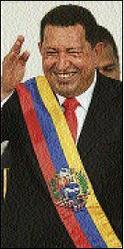
Venezuela's President Hugo Chávez is seen waving after being sworn in for a third term in Caracas, on January 10, 2007. Venezuela has renamed its currency the 'strong bolivar' with 100 strong bolivars as the highest denomination. - File
Venezuela launched a new currency with the new year, lopping off three zeros from denominations in a bid to simplify finances and boost confidence in a money that has been losing value due to high inflation.
President Hugo Chávez's government says the new currency - dubbed the 'strong bolivar' - will make daily transactions easier and cure some accounting headaches. Officials also say it is part of a broader effort to contain rising prices and strengthen the economy.
"We're ending a historical cycle of ... instability in prices," Finance Minister Rodrigo Cabezas said Monday, adding that the change aims to "recover a bolivar that has significant buying capacity."
Prices have risen as Chávez has pumped increased amounts of the country's oil income into social programmes, reinforcing his support among the poor and helping to drive 8.4 per cent economic growth in 2007.
The central bank is promoting the new monetary unit with an ad campaign and the slogan: "A strong economy, a strong bolivar, a strong country." Officials, however, have yet to clearly spell out their anti-inflationary measures.
Some Venezuelan critics, meanwhile, have dubbed the new currency the "weak bolivar," noting its predecessor, the bolivar, has seen its purchasing power suffer in an economy where inflation ran roughly 20 per cent in 2007 - the highest in Latin America.
Venezuelan economist and pollster Luis Vicente Leon said that while the new currency may provide "the perception of stability" for some, it is largely a "cosmetic change."
Government officials say the change is overdue to bring Venezuelan denominations into line with those of other countries in the region.
Instead of denominations in the thousands, the largest new Venezuelan note will be 100 strong bolivars.
"It was necessary to leave behind the consequences of a history of high inflation," central bank president, Gaston Parra, said in a televised year-end speech.
Devaluation
He said officials aim "to reinforce confidence in the monetary symbol."
The new money was distributed to banks and automated teller machines nationwide ahead of Tuesday's launch and will be phased in during the next six months. Venezuelans will be able to use both old and new bolivars during the transition.
Venezuela has had a fixed exchange rate since February 2003, when Chávez imposed currency and price controls.
The government has said it is not considering a devaluation any time soon.
But, while the strong bolivar's official exchange rate will be fixed as 2.15 to US$1, the black market rate has hovered around the equivalent of 5.60 to US$1 recently.
Venezuela's currency has long been named after independence hero Símon Bolivar, who is pictured on the new 100 strong bolivar bill.
The new money is the latest in a series of changes to national symbols during Chavez's presidency.
He also redesigned the national seal and flag, and renamed the country the Bolivarian Republic of Venezuela.
With the new currency, the government is also resurrecting a 12.5-cent coin, called the 'locha', which existed during Chávez's childhood but has not been used since the 1970s.
- AP


















