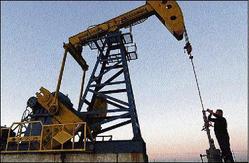
A labourer works at a pump jack in PetroChina's Daqing oil field, in China's northeastern Heilongjiang province, on November 4. Oil futures rose to US$100 per barrel then retreated yesterday. Surging economies in China and India, fed by oil and gasolene, have sent prices soaring over the past year. - File
Crude oil prices soared to US$100 a barrel yesterday for the first time, reaching that milestone amid an unshakeable view that global demand for oil and petroleum products will outstrip supplies.
Surging economies in China and India, fed by oil and gasolene, have sent prices soaring over the past year, while tensions in oil-producing nations like Nigeria and Iran have made investors increasingly nervous and invited speculators to drive prices even higher.
Violence in Nigeria helped give crude the final push over US$100.
Bands of armed men invaded Port Harcourt, the centre of Nigeria's oil industry on Tuesday, attacking two police stations and raiding the lobby of a major hotel.
Word that several Mexican oil export ports were closed due to rough weather added to the gains, as did a report that OPEC may not be able to meet its share of global oil demand by 2024.
Light, sweet crude for January delivery rose US$4.02 to US$100 a barrel on the New York Mercantile Exchange, according to Brenda Guzman, a Nymex spokeswoman, before slipping back to $99.27.
In London, February Brent crude rose US$3.12 to US$97.59 a barrel on the ICE Futures exchange.
Oil prices are within the range of inflation-adjusted highs set in early 1980.
Depending on how the adjustment is calculated, US$38 a barrel, then, would be worth US$96 to US$103 or more today.
The White House yesterday said it would not release oil from the nation's strategic reserves to drive prices lower.
"This president would not use the (Strategic Petroleum Reserve) to manipulate (prices) unless there was a true emergency," said White House press secretary, Dana Perino.
As of early November, the Strategic Petroleum Reserve contained 694 million barrels of oil.
The government is working to fill it to its 727 million barrel capacity.
The solution to high prices lies in expanding domestic oil and gas production and increasing the nation's refining capacity, Energy Department spokeswoman, Megan Barnett, said.
Crude prices, which have flirted with US$100 for months, have risen in recent days on supply concerns, exacerbated by Turkish attacks on Kurdish rebels in northern Iraq and falling domestic inventories.
Supply concerns
However, post-holiday trading volumes were about 50 per cent of a normal Wednesday, meaning the price move was likely exaggerated by speculative buying.
"I would imagine the speculators are the biggest drivers today," said Phil Flynn, an analyst at Alaron Trading Corp, in Chicago.
It's hard to say whether prices would have risen as quickly on a normal trading day, Flynn said. While oil has soared on mounting supply concerns in recent months, speculators have often been cited as a reason for the swiftness of oil's climb.
Moreover, many of the concerns about supply disruptions have yet to materialise, but that hasn't stopped buyers from driving prices higher.
"Although the (Nigerian) violence has not impacted oil flow out of the country, it has reignited supply concerns as militant attacks have reduced Nigeria's crude output by roughly 20 per cent since 2006," said John Gerdes, an analyst at SunTrust Robinson Humphrey, in a research note.
Nigeria is Africa's largest oil producer.
Separately, the Organisation of Petroleum Exporting Countries said its member nations may not be able to meet demand as early as 2024, though OPEC also said that deadline could slide for decades if members increase production more quickly.
- AP


















