Paul H. Williams, Gleaner Writer
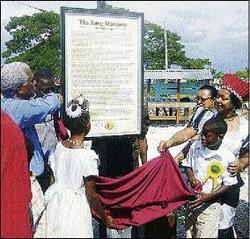
The storyboard of the Zong Massacre is unveiled by Mayor of Black River Jeremy Palmer (left) and Whitney Baker (second left), Jamaica Cultural Development Commission's (JCDC) 2007 Mini Miss St. Elizabeth; Sharick Simpson (second right), 2007 JCDC's...
In November and December 1781, something very evil and sinister happened in the Atlantic Ocean.
One hundred and thirty-three ill Africans, who were en route to the West Indies on the slave ship, The Zong, were chained and thrown overboard. The captain, a Mr. Collingwood, reasoned, "if those who were ill eventually died from natural causes, the merchants or the consortium would have to absorb the financial loss; but the insurers would pay ... if it could be proven that the Africans drowned".
The matter was brought before the British courts, not for the mass killing, but because the insurers refused to pay ship owners, James Gregson et al, compensation for the loss. The court contended that "the ship owners could not claim insurance on the slaves because the lack of sufficient water demonstrated that the cargo (the slaves) had been badly damaged".
The chain of events, exposed by Olaudah Equiano, a former slave, precipitated the slave trade abolition movement; and slavery officially ended May 1, 1807.
Commemorative event
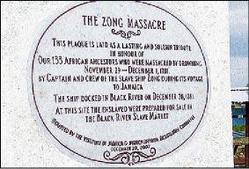
The plaque commemorating the Zong Massacre in Black River, St. Elizabeth. - Photos by Paul Williams
On Friday, December 30, exactly 226 years after The Zong arrived at Black River, The Institute of Jamaica and the Jamaica National Bicentenary Committee (JNBC) unveiled a plaque and storyboard, by the Black River Market, in St. Elizabeth, in memory of the murdered Africans. The event was part of the activities to commemorate the bicentenary of the abolition of the 'transatlantic slave trade'.
Professor Verene Shepherd of the University of the West Indies and chair of the JNBC, in her address to the gathering, said: "This plaque and this ceremony are in everlasting memory of the anguish of our ancestors on The Zong."
In closing, she said her "only response to such atrocities is Buju Banton's lyrics, 'Murderer, blood is on your shoulder ...'."
Senator Warren Newby, Parliamentary Secretary in the Ministry of Information, Culture, Youth and Sport, and representing Olivia Grange, his senior minister, laid a wreath at the base of the monument bearing the plaque.
After a lengthy session in the pelting Black River sun, Vivian Crawford, executive director of the Institute of Jamaica, acknowledged those who organised, participated in, and witnessed the days" activities. Immediately before his light-hearted and sometimes humorous conclusion, Aberdeen Primary and Junior High School treated the audience to quadrille, camp style.


















