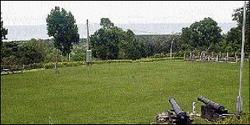
Cannons are among the relics at the Seville heritage site, the first capital of colonial Jamaica under Spanish rule. - Ian Allen/Staff Photographer
The Editor, Sir:
Recently, I took a trip to the Seville Heritage Park in St. Ann's Bay. I was so intrigued with what I saw that I went ahead and did some research on it. What I found out was so interesting I have to share it with you and my fellow Jamaicans.
Seville Heritage Park is located just outside the parish capital of St. Ann's Bay and seven miles from the tourist mecca, Ocho Rios. Seville Heritage Park is known for its beauty and historical authenticity. There you will find evidence of Jamaica's rich culture, revealed in artefacts from our Taino, Spanish, British and African ancestries.
The site of the town
Seville is the site of the town of Maima, which was established by the Tainos, the first inhabitants of Jamaica. An exhibition of artefacts at Seville helped me to understand how these first Jamaicans lived. It is reported that on the evening of May 5, 1494, Christopher Columbus, the Spanish explorer, landed at Seville and became the first European to tread upon Jamaican soil.
"The most beautiful place I have ever set eyes on" is how Christopher Columbus described the island of Jamaica. He lived here for over a year after he was shipwrecked. In 1509, the Spaniards', under Esquivel, Seville La Neuvo was built in the middle of the village of Maima. They subsequently abandoned it in 1534. On my tour of the Seville Heritage park, I discovered the ruins of the Spanish Church of Peter Martyr, the ruins of the Spaniard-fortified castle (Governor's House) as the base of the Spanish sugar mills. I learnt that the most recent excavations have revealed a Spanish artisan workshop, estimated to be one of the earliest so far discovered in the New World.
At Seville there are replicas of the African and Taino houses. Here you will learn about the variety of food our ancestors ate. I also saw the site where the remains of four of our ancestors were reburied in 1997 in a ceremony marked by ritual and respect of their ancestry. It is reported that it was here at Seville that the cultures of three worlds - Amerindians, African and European had their first encounter, and through good times and bad times gave birth to modern Jamaica. It was an encounter that brought turbulence, sorrow and tragedy. The Amerindians and their civilisation were virtually destroyed. The Africans were enslaved and the Spanish and English battled for supremacy.
It is said that it was here that the ingredients of our culture were first put together, creating the unique blend that is Jamaica's national heritage.
I would encourage all Jamaicans to take the time out to visit the Seville National Heritage Park where you can see and enjoy our rich history and culture.
I am, etc.,
RUPERT GAREL
5 Gordon Tennant Road
St. Ann's Bay