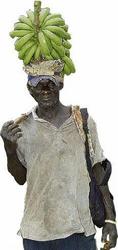
Banana grower, Fitzroy 'Fitzie' Martin, balances a bunch of green bananas as he makes his way home from his farm at Stettin in south Trelawny. The European Union has promised funding to cushion the economic impact on the banana sector as the new trade pact with Cariforum takes effect. - photo by Noel Thompson
The European Union (EU) is to allow Caribbean bananas unfettered market access, nullifying a recent World Trade Organisation (WTO) ruling that sides with countries like Ecuador which have been demanding a lifting of the protective veil from the EU's former colonies.
And in another trade concession that helped to secure a new Cariforum-EU Economic Partnership Agreement (EPA) last weekend, the Europeans have agreed an additional 60,000-tonne quota for regional sugar.
Regional bananas will gain duty-free and quota-free access to the EU starting January 1, relieving the region from having to go head to head on price with competing Latin Americans' so-called 'dollar banana' producers - a contest they would lose.
Exempt producers
This means that the recent ruling by the WTO's dispute settlement panel against preferential EU market access and prices to ACP banana exporters will not apply to CARICOM/Dominican Republic producers, said Am-bassador Richard Bernal, director general of the Carib-bean Regional Nego-tiating Machinery.
Under the current banana regime, implemented in 2006, African, Caribbean and Pacific countries have duty-free entry for 750,000 tonnes of the fruit, while LatAm farmers pay customs duty of €176 per tonne.
Still, Bernal concedes that the EPA compromises were on both sides - for example, the Caribbean had wanted access for an additional 200,000 tonnes of sugar, but was only conceded 60,000 tonnes, much to the disappointment of local cane farmers.
"Some is better than nothing," said Allan Rickards, chairman of the All Island Jamaica Cane Farmers Association. "We accept it and we are going to put it to good use."
Offset lost income
The additional volume is expected to offset lost income from the three-tiered, phased price cuts for regional sugar.
Bernal said that half, or 30,000 tonnes, of the added quota will be split among CARICOM producers under the reigning sugar protocol - only three of five countries are expected to continue producing raw sugar for export - with the remainder going to the Dominican Republic.
The sugar protocol will cease to exist in September 2009, says Bernal.
Rickards said the CARICOM portion would likely be shared among Jamaica, Belize and Guyana, and would likely push Jamaica's full quota to 150,000 tonnes in a few years.
"That, for me, is manageable because when you add that to the local requirement needs of 60,000 tonnes to 70,000 tonnes," he said, "that brings us to 210,000 tonnes and our first target for production is 200,000."
The countries more likely to be hit by the smaller-than-expected market concession would be Guyana and Belize, said Rickards, especially Guyana, which dominates regional sugar and is in growth mode.
In fact, the Guyana Sugar Corporation Inc. will commission its new 110,000-tonne factory at Skeldon in the first half of 2008.
In the crop just ended in July, the region outputted 591,000 tonnes, nearly all of which, 526,000 tonnes, was exported. The EU accounted for 85 per cent of exports.
Fairly vibrant sector
But while sugar production was slightly below the 600,000-tonne target last year, the sector was fairly vibrant, while bananas have been on a freefall - hurt by a more restrictive export market following successful arguments for fairer trade for the fruit, and latterly, Hurricane Dean, which decimated crops in Jamaica and elsewhere.
Bernal says the new Cariforum banana deal for duty-free preference which was struck within the framework of the EPA would be protected under WTO rules governing free trade areas, notwithstanding that body's own decision at the end of November that the EU banana regime went against the grain of free trade among member nations.
The ambassador also disclosed that the EPA contains a comprehensive Joint Declaration on Bananas, which commits the EU to funding adjustments in the sector to mitigate social impacts that might result from adjustments to the new trading environment.
dionne.rose@gleanerjm.com


















