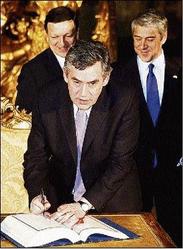
Britain's Prime Minister Gordon Brown signs the EU treaty of Lisbon as Portugal's Prime Minister Jose Socrates (right) and EU Commission President Jose Manuel Barroso (left) look on at the National Coach Museum in Lisbon, Portugal, yesterday.
- Reuters
LISBON (Reuters):
European Union leaders signed the Treaty of Lisbon yesterday to overhaul the bloc's creaking institutions and give it stronger leadership.
At an elaborate ceremony at Lisbon's grandiose Jeronimos Monastery, leaders said the treaty would open a new chapter in European history by giving the 27-nation bloc a more robust foreign policy and more democracy in decision making.
Found solution
"This was the European project that many generations dreamt of and others before us championed, with a vision of the future," Portuguese Prime Minister Jose Socrates told leaders.
The treaty replaces a more ambitious constitution abandoned after French and Dutch voters rejected it in 2005. It preserves most of the key institutional changes, but drops contentious symbols of statehood such as a flag and anthem.
"Europe was blocked, without knowing how to move forward and we found the solution with this treaty," French President Nicolas Sarkozy told reporters.
EU leaders hope the pact will adapt the bloc's structures to cope with enlargement after it opened its doors to 12 mostly ex-communist states in 2004 and 2007. Critics say it will curb national sovereignty further and put more power in Brussels.
Long-term presidents
"For the first time, the countries that were once divided by a totalitarian curtain, are now united in support of a common treaty that they had themselves negotiated," European Commission President Jose Manuel Barroso told the leaders. "It is the treaty of an enlarged Europe from the Mediterranean to the Baltic, from the Atlantic Ocean to the Black Sea."
The bloc's rotating presidencies will be replaced in 2009 with a long-term president of the European Council, who will chair summits, and a stronger foreign policy chief, who will chair foreign ministers' meetings.
The treaty will allow more decisions to be taken by majority voting, notably on justice and security issues, and give more say to the European and national parliaments. A charter of fundamental European rights is attached to the treaty.