Ven Griva, Contributor
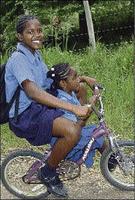
Young Yanique Graham demonstrates a good deed as she tows her friend Ashley Sanderson home from school on a bicycle along the Bigwoods main road in St. Elizabeth. Both are students of the Bigwoods Primary and Junior High School. - Noel Thompson/Freelance Photographer
Learning to ride a bicycle is a childhood rite of passage that leaves many a youngster with fond memories - if not permanent scars on their elbows and knees.
Now a study conducted by the (U.S.) Center for Injury Research and Policy at Nationwide Children's Hospital concludes that bicycle-related injuries to young riders in the United States could be a more significant public health concern than previously recognised.
The combined cost in hospital stays for young Americans injured in bicycle accidents is estimated to be $200 million per year, says the study published in the October issue of Injury Prevention. Children and adolescents aged 20 and younger comprise more than half of the estimated 85 million bicycle riders in the United States.
It has been long known that bicycle-related injuries result in more emergency department visits for children than any other recreational sport.
Associated injuries
"Bicycles are associated with more childhood injuries than any other consumer product except the automobile," said Dr. Gary Smith, director of the Center for Injury Research and Policy and faculty member at The Ohio State University College of Medicine. "The high rate of hospitalisation and use of health care resources identified in our study supports the need for increased attention to bicycle-related injuries."
The first-of-its-kind study focused on the approximately 10,700 U.S. children injured in bike accidents each year and admitted at least overnight to the hospital. On average, those studied remained hospitalised for at least three days.
Among the study's significant findings:-
One-third of children hospitalised in bike accidents were diagnosed with traumatic brain injury.
Motor vehicles were linked to about 30 per cent of bicycle-related hospitalisations.
The motor vehicle link increased as children got older.
Helmets, knee pads, elbow pads and wrist guards, if worn, can reduce the severity of bicycle-related injuries.
"The findings from our study can be used to promote targeted prevention strategies to lessen the severity of injury and the number of deaths resulting from paediatric bicycle-related injuries," said Smith, one of the study's authors. "We know that bicycle helmets can reduce the risk of brain injury by up to 85 per cent. We need to increase efforts to promote helmet use by children riding bicycles."
Visit Copley News Service at www.copleynews.com


















