Kenneth Gardner
Successful weight training programmes involve following methods that have been scientifically proven to produce results. It is essential that weight trainers use very strict biomechanics when working out as poor exercise form causes cheating which makes the exercise easier to perform but robs the working muscles of some of the needed stress.
Biomechanics involves maintaining the correct form in each exercise and this ensures that your working muscles receive the full stress from the exercise and that your body positions are such that your muscles and joints are in the strongest possible position, thereby reducing the chance of a training injury.
Maintaining correct form, in essence, is moving your limbs or trunk over the widest possible range of motion in each exercise while moving only those parts of the body specified by the movement description. Short range movements produce less result than full range movements and cheating through body motion reduces the value of the exercise and leaves your body more open to injury.
Elbows only
An example of correct exercise form can be observed in doing the popular biceps exercise — barbell curls. This exercise is done by taking an undergrip on a moderately weighted barbell with hands and feet set shoulder width apart while standing erect with arms straight down at your sides and the barbell resting across your upper thighs.
From this position, a proper barbell curl is performed by bending only the elbows and moving the forearms to carry the barbell forward and upward in a semicircular arc to a finish position beneath your chin. To complete the movement, you simply return the barbell along the same arc to the starting position.
Using correct biomechanics in the barbell curl requires that the upper arms remain motionless while pressed against the sides of the ribcage throughout the movement. The torso is held upright and is kept motionless throughout both the upward (positive) and downward (negative) cycles of each movement.
Here is a list of upper body exercises for you to do.
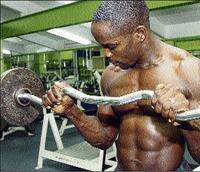
The correct form is important in weight training. Here exercise instructor, Kurt Dunn, performs reverse curls at Gymkhana at the Hilton Kingston hotel. - Rudolph Brown/Chief Photographer
Standing dumbbell curls (biceps exercise)
Grasp two dumbbells and hold at sides with feet shoulder width apart.
Curl dumbbells forward and upwards towards your lower chin.
Lower the dumbbells back to the starting position and repeat.
Barbell upright rows (back exercise)
Take a narrow overgrip in the middle of a barbell handle.
Set feet shoulder width apart with barbell resting across your upper thighs.
Slowly pull the barbell upwards until the back of your fists are touching the underside of your chin.
Lower the weight to the starting position and repeat
Universal triceps exercise (triceps exercise)
Place both hands on the high pulley bar (lat machine) with your palms down and thumbs locked.
Exhale as you push the bar down until your arms are straight.
Keep upper arms by your sides and move only your forearms.
Inhale as you allow your forearms to slowly return to the starting position.
Universal pec deck (chest exercise)
Start in a seated position with your elbows bent and your forearms on the padded exercise bar.
Adjust the seat so that your elbows are shoulder width apart.
Exhale as you pull your arms forward and towards each other.
Keep pulling until the exercise bars gently touch each other.
Inhale as you slowly allow your arms to return to the starting position.
Kenneth Gardner is an exercise physiologist at the G. C. Foster College of Physical Education: email: yourhealth@gleanerjm.com.


















