
Eulalee Thompson
Talking and writing about the environment is just not a very sexy topic. People generally find environmental talk esoteric because most times they can't immediately relate it to the bread-and-butter issues affecting their daily lives. Also, environmental change is often insidious and nobody really cares until the effect smacks them right in the face.
Take this matter of climate change, for instance. I remember being a member of the Inter Press Service team of journalists that covered, in the 1990s, that massive environment meeting known as the United Nations Conference on the Environment and Development (UNCED), in beautiful Rio de Janeiro, Brazil (and most of the follow-up meetings).
There, at this once-in-a-lifetime experience, many great minds on this planet, including many Jamaican experts, spoke to the urgency to arrest decay that leads to climate change (and other major environmental ills) and documents setting the blueprint for global sustainable development like Agenda 21 (the programme of action adopted by the UNCED), were produced. Still the planet waited and waited and now we are not just talking but seeing vividly the effects of climate change; extreme weather conditions are now forcing us to sit up and listen.
The greenhouse effect
Climate change is not a peripheral discussion; it impacts directly the quality of our lives and our general health and well-being and I will soon show you how. The climate is changing because of human activities; when we burn fossil fuels (oil, coal and natural gas) without a care, excessive amounts of carbon dioxide are pumped into the atmosphere (our oceans are also absorbing more and more of this large amounts of carbon dioxide).
The 'greenhouse effect' is enhanced as this carbon dioxide (and other by-products) accumulates in the lower atmosphere, entering the thin blanket that insulates Earth, contributes to warming the atmosphere, heating the oceans, setting the stage for changes in weather pattern.
Diseases are emerging
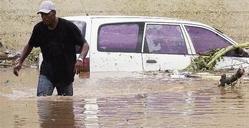
Global climate change is being blamed for extreme weather conditions, such as flooding, and the emergence in disease. - Peta-Gaye Clachar/Staff Photographer
The Harvard Medical School Centre for Health and Global Environment has produced a detailed document called Climate change futures: Health, ecological and economic dimensions where it states that 'health is the final common pathway of the natural systems we are part of, and climate instability i the patterns of disease and the quality of our air, food and water.'
In the case of allergic diseases, for instance, one of the writers in the document, Christine A. Rodgers, notes that allergic diseases have a strong genetic component but the rapid increases in occurrence of these diseases (which we are now seeing) is likely to be the result of changing environmental exposures.
She further states that 'while the role of allergen exposure alone in causing allergic diseases is unknown, allergens from pollen grains and fungal spores are unequivocally associated with exacerbation of existing disease. Changes in atmospheric chemistry and climate that tend to increase the presence of pollen and fungi in the air therefore contribute to risk of allergic symptoms and asthma'.
Mosquitoes are biting
It's not only respiratory conditions which are affected by an atmosphere increasingly drenched with carbon dioxide but infectious and vector-borne conditions. Take the upsurge in malaria cases for example, and certainly Jamaicans should relate to this; perhaps, it's not just slacking off in the Health Ministry's public health systems that's at fault but global environmental changes. The Harvard study points to three case studies of weather patterns that impact malaria - flooding in Mozambique, the indirect impacts of drought in northeast Brazil on malaria distribution and the impacts of warming an precipitation patterns affecting the potential range of malaria in the highlands of Zimbabwe.
Scientists believe that changes in the planet's ecological balance and climate are impacting the resurgence and redistribution of diseases associated with animal vectors such as mosquitoes, ticks, deer, birds and rodents. The World Health Organisation has reported the emergence of over 30 diseases between 1976 and 1996, though not all vector-borne, they include HIV/AIDS, Ebola, toxic E. coli, Lyme disease and a new hantavirus.
Unfortunately, I am now over my word count so I can't elaborate on some of the issues raised above, but I could briefly point out, that in the case of for example, the malaria germ which is carried by mosquitoes, flooding provides the condition for outbreaks and mosquitoes also do well in warmer climates biting us more often and reproducing themselves more rapidly as their breeding season is lengthened and the malaria-causing germ in their bodies matures quicker in warmer weather.
eulalee.thompson@gleanerjm.com


















