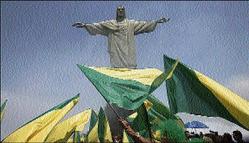
Brazilian fans wave flags in front of the Christ the Redeemer statue in Rio de Janeiro yesterday. Brazil, the only bidding country, was named host of the 2014 World Cup finals by world soccer's governing body, FIFA. - Reuters
ZURICH (Reuters):
BRAZIL, THE only bidding country, was named as the host nation of the 2014 World Cup finals by FIFA, world soccer's governing body, yesterday.
It becomes the fifth country to host two World Cups following Mexico (1970 and 1986), France (1938 and 1998), West Germany/Germany (1974 and 2006) and Italy (1934 and 1990).
Brazil, who have won the World Cup a record five times and are the only country to have played in all 18 World Cup finals tournaments, last staged the event in 1950.
Brazil become the first South American hosts since Argentina staged and won the 1978 World Cup finals.
Brazil was the only country nominated to bid for the World Cup by the South American confederation (CONMEBOL) whose turn it was to stage the finals after they were awarded to Europe (Germany) in 2006 and Africa (South Africa) in 2010.
Eighteen cities have bid to stage matches and, according to the FIFA inspection report published last week, it is envisaged that between eight to 10 cities will host games.
Stadiums not ready
However, the report, while giving the bid its blessing, says that none of the stadiums are currently up to FIFA safety standards for staging World Cup matches.
That includes the Maracana in Rio de Janeiro, which held a world-record crowd of 199,000 for the 1950 final.
Brazil was the only contender because of FIFA's policy of rotating World Cups through its six continental confederations, a strategy that was scrapped on Monday.
More than 160 Brazilian delegation members and media were in Zurich for yesterday's announcement including the President of Brazil, Luiz Inacio Lula da Silva, Romario, a member of Brazil's 1994 World C
We can justify cost - organisers
RIO DE JANEIRO, (Reuters):
BRAZIL HAS promised it can meet the huge costs of staging the 2014 World Cup and that the legacy of improved public services and foreign investment will justify the expenses involved.
But, amid the jubilation which followed FIFA's decision to award the tournament to the country yesterday, there were also worries that public spending could spiral out of control.
Brazil currently does not have a stadium which meets the requirements for a World Cup finals match and at least 10 to 12 arenas would have to be completely reformed or built from scratch.
Eighteen stadiums have been put forward on a preliminary basis of which 14 already exist and four would be brand new.
Cost estimates
The Brazilian Football Con-federation (CBF) has estimated that the stadiums alone would require investments of US$1.1 billion, which it said would come from the private sector.
"The model (of investment) gives priority for private investment in the construction and reform of the stadiums," said CBF president, Ricardo Teixeira, during his presentation to FIFA in Zurich, on Tuesday.
In an interview with O Globo newspaper, two days earlier, Teixeira said the CBF had already been in contact with foreign investors over stadium reforms.
Apart from the stadiums, spending on infrastructure will be provided by federal, state and city governments.
"It will leave an important inhe-ritance for the future," said Teixeira. "There will be improvements in transport infrastructure, hospitals and a significant improvement in public security."
However, no budget has been publicly announced for non-sporting infrastructure, increasing concerns of uncontrolled government spending.
Those concerns have bee because the Pan American Games, which took place in Rio de Janeiro earlier this year, were widely reported to have over-run original cost estimates by 900 per cent.
The event also failed to leave long-term improvements in transport, environment and public safety after original projects were abandoned.