Kenneth Gardner
Overweight, obesity, poor dieting practices and a sedentary lifestyle are a few of the risk factors for breast cancer. Regular physical exercise has been identified as the only natural and successful medium to counter the effects of these lifestyle factors and, by extension, breast cancer.
Exercise contributes to weight management through increased resting metabolic rates. This means that a person will burn more calories while at rest and can, therefore, consume more calories without gaining weight. With an improved efficiency in our metabolic activities, the development of obesity (or being overweight) is less likely and, likewise, there is a reduction in cancer development.
Research has revealed that women who did regular physical exercise reduced their risk of developing breast cancer by about 20 per cent. Regular exercises such as walking, swimming or cycling, three to five times a week, had the greatest impact. While regular physical activity is no substitute for medical treatment, it has been quite successful in both the prevention and treatment of breast cancer by maintaining healthier body weight, reducing fat deposits and increasing fat metabolism.
Oestrogen
Oestrogen has been labelled as a cancer promoter and is linked to increased risk of breast cancer. Oestrogen encourages the growth of cells in a number of sites, including breast tissues and the uterus. Regular physical exercise lowers the levels of oestrogen in the body, thus minimising the chances of breast cancer development.
Kenneth Gardner is an exercise physiologist at the G.C. Foster College of Physical Education: email: yourhealth@gleanerjm.
Here are three simple exercises which you can do:
Swiss ball dumb-bell shoulder press (shoulder exercise)
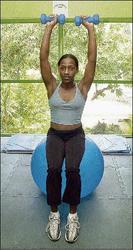
Hold a pair of dumb-bells, one in each hand. Sit on swiss ball with feet set comfortably apart for balance. Place hands slightly wider than shoulder width and in line with shoulders. Inhale while pressing the weight overhead to a straight arm position. Exhale while lowering the weight to the starting position.
Swiss Ball lateral leg raise (leg exercise)
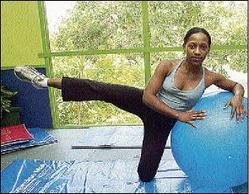
Kneel beside a swiss ball with hands on top of the ball for balance. From the hip, move the leg furthest away from the ball upwards, while keeping the leg straight. Lower leg to initial position and repeat movement.
Swiss ball jack knife (back exercise)
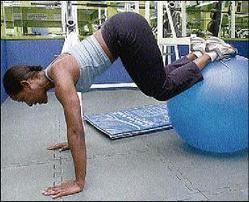
Lie face down on a swiss ball with hands placed shoulder width apart on the floor for balance. Start with ball underneath your quads (above knees). Exhale and pull hips inwards bringing the ball to your shins. Return to start and repeat.


















