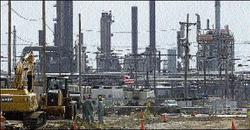
The BP Refinery in Whiting, Indiana is seen September 7. BP plc, which announced a reorganisation plan Thursday, expects revenues to increase in the fourth quarter and that refinery throughput will increase in Whiting. Its number two operation, bpTT,...
Oil company bpTT says plans by its UK parent to restructure will have no major impact on its Trinidad operation.
Dr Tony Hayward, who took the top spot at BP plc in May, announced last Thursday that he would be reorganising the oil giant's operations into two core business units under plans to drive up performance.
The company's Trinidad operation issued a statement almost immediately, saying its performance has been 'solid' in the past year and was unlikely to see any big changes.
"It is not anticipated that the new direction will significantly impact bpTT," said the company statement.
Number two producer
Trinidad contributes 10 per cent of BP's global business, and is the number two producer behind TNK BP in Russia.
"bpTT's strategy remains to safely and reliably maintain production of about 500,000 barrels of oil equivalent for the long-term," the company said.
"In some cases the company's contracts will last for the next 25 years."
The company, which reasserted that it has had a solid year of safe production, says its contribution to the group is set to grow.
Its two newest platforms, Mango and Cashima, are soon expected to start delivering gas supplies.
Hayward took over as chief executive officer of BP on the departure of Lord Browne, following public disclosures about the latter's private life and allegations he had misused company assets.
The BP plc board cleared him of the latter, but said he would depart without a pound 15 million handshake that would have been due to him.
On October 11, five months after Hayward's ascension, the company announced it would be moving to simplify the company's structure to free operating managers of 'corporate bureacracy' and cut overheads.
"Our problem is not about the strategy itself but about our execution of it. BP's performance has materially lagged our peer group in the last three years," said Hayward.
"It has been poor because we are not consistent and our organisation has grown too complex."
Hayward said the two business segments will be called Exploration & Production and Refining & Marketing.
The current third segment, Gas, Power & Renewables, will be absorbed into the two.
A separate division Energy, will handle BP's low carbon business and future growth options outside oil and gas.
"For our part," said bpTT, "we intend to build on the great performance we have delivered so far and remain an integral part of Trinidad and Tobago's long-term development and BP's future."
At the end of 2006, bpTT chairman and CEO Robert Riley said the company ranked in the top quartile of strategic business units globally in safety performance.
Exploration and production licences
The oil company holds exploration and production licences covering 904,000 acres in marine areas, off Trinidad and Tobago's east coast.
Its combined oil and gas production averaged 430,000 barrels of oil equivalent per day (boed) in 2006, representing approximately 10 per cent of BP group's production.
In 2006, bpTT contributed 14.4 per cent to the GDP of Trinidad and Tobago's economy and accounted for 32 per cent of the petroleum sector activity here.
Hayward anticipates that BP will see improvements in the fourth quarter.
"We expect the revenue gap to narrow as major new production comes on stream in the fourth quarter, and refinery throughputs rise at Texas City and Whiting over the coming months," he said.
business@gleanerjm.com


















