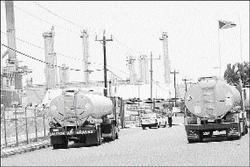
Oil tankers heading toward Petrojam Refinery, seen in the background. The refinery is being expanded and fitted to refine even heavier and cheaper crudes than the 23-28 API it now processes. - Rudolph Brown/Chief Photographer
Oil thundered more than two dollars to a new peak above US$88 a barrel on Tuesday, extending a nine-dollar rally since last week on tight supplies, strong demand and growing tensions in northern Iraq.
Jamaica's oil bill, while not escalating at the same levels, is also expected to rise.
The record surge raised alarm bells for producer group OPEC, which voiced concern over the high price and blamed rampant speculation by big money investors rather than any shortage of supply.
"While the organisation does not favour oil prices at this level, it strongly believes that fundamentals are not supporting current high prices and that the market is very well supplied," it said in a statement.
Implications
Jamaica buys most of its oil directly from Venezuela - 23,000 barrels per day under the PetroCaribe arrangement - but events in the world market have implications for the oil bill, since the price paid to PDVSA is "allied to the world market," says energy expert Dr. Raymond Wright, but tends to be below prevailing market prices.
The country's oil import bill is running at about US$1.8 billion to US$2 billion per annum. The spend on petroleum products represented about 15 per cent of GDP in 2005/06, according to the central bank.
The price Jamaica pays for its oil is "confidentially negotiated and cannot be disclosed to a third party," according to Petrojam managing director Winston Watson.
But: "I can tell you that the PDVSA crude price basket is approximately US$73/bbl," he told Wednesday Business on Tuesday.
Jamaica also buys some of its oil at world-market prices, with the price determined by the lightness of the crude.
The grade of crude processed by Petrojam is 23-28 API (American Petroleum Institute).
West Texas intermediary, which Wright says commands the highest price, is 32 API and lighter.
The heavier the crude, the cheaper the oil, hence the ongoing upgrade of the Petrojam - which will boost its production from 36,000 to about 50,000 barrels per day - is meant to put the refinery in a position to process even heavier crudes.
Meantime, oil prices have hit new highs three straight trading days.
On Monday, prices rose above US$86, while U.S. crude settled up $1.48 Tuesday at US$87.61 a barrel, easing off the earlier record high of $88.20.
London Brent rose $1.41 to US$84.16 a barrel.
Set records
Oil, which has set records for three straight days, is closing in on the inflation-adjusted high of US$90.46 seen in 1980, the year after the Iranian revolution and at the start of the Iran-Iraq war. Prices this year have averaged US$67.
Investors said oil's rally was supported by tensions between Turkey and Kurdish separatists in northern Iraq, sturdy world energy demand growth, tight inventories in consumer nations heading into winter and unprecedented weakness in the U.S. dollar.
"This market has it all right now," said Peter Beutel, president of energy trading consultant Cameron Hanover.
"It has supply concerns, projected increases in demand, dollar weakness, momentum and political fears."
FREIGHT TRAIN
The U.S. Energy Information Administration said on Tuesday that the market needs additional oil from producer group OPEC, only days after the top oil official of the United States said another hike may not be needed.
OPEC officials said they had heard no discussion within the organisation about raising output beyond the 500,000 barrels per day agreed in September, which takes effect on November 1.
"The market fundamentals are in balance. There is too much money coming into the market," Indonesia's OPEC governor Maizar Rahman told Reuters.
Oil has climbed from below US$70 in mid-August and surged 10 per cent since October 9.
The rally has also been aided by fund buying as a hedge against a weaker dollar. Gold has hit a 28-year high and platinum breached record levels.
Oil prices have more than quadrupled since 2002 and climbed 43 per cent since the start of 2007.
- Reuters and Gleaner reports


















