Paul H. Williams, Gleaner Writer

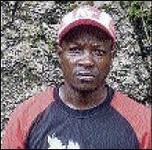
Devon McLaughlin
Their face is not on your paper money; you haven't read about their deeds in books, and they have not received any national award. But, their deeds are as heroic as those of famous men of valour. In their own little corner, and in ways that only they can, they have been saving lives.
The community in which they live is perched on a steep hillside overlooking the Rio Cobre and the Flat Bridge, in St. Catherine's Bog Walk gorge, a scenic place with interesting natural features. Yet, it can be quite beguiling, especially during periods of heavy rain.
So, from time to time, unsuspecting motorists get trapped in the unrelenting waters, and some lose their lives. And, for some reason, the tragedy is usually near the Flat Bridge, a legendary piece of architecture, whose history and notoriety are shrouded in doom and destruction. Death, it would appear, walks Flat Bridge and its vicinity: and according to Devon McLaughlin, when the river turns copper (cobre), it must get blood.
Devon: "This bridge is a haunted bridge. Mi born an grow here. People jus goh over simply, no speed, no carelessness; yuh can't be too careful - and yuh see when the river is in khaki suit (brown), it dangerous. It not gwine change in colour until somebody dead." This might sound like an old-wife's tale, but Devon should know. He's one of the heroes of Flat Bridge.
DEADLY WATERS
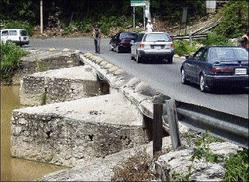
Motorists drive along the deadly Flat Bridge. -
photos by Paul h. Williams
Standing at just over five feet, and aged 46, diminutive Devon is unbelievably strong. But, he's soon to retire from diving into the Flat Bridge section of the Rio Cobre to save travellers who get into difficulty in its deadly waters.
He has been saving lives since he was 15. His first rescue was never a challenger as he was well prepared mentally and physically. His father, himself, was a rescuer. As a child, Devon would watch him and other rescuers and learn. Devon: "My father save life, and mi see how my father do the work, and my father get old, soh mi tek it up."
He recalled the days when there were no street lights in the gorge. The nights were as black as pitch. And in those dark nights there were many accidents. Devon: "When time we hear, boodudoofboof!, cause no light never deh ere, we run come dung, wi know supp'n gwine go over there - we know sey we affi come help people, cause people need the assistance - any time a night, any hour cause wi noh fraid."
In the cold nights, they would sprint down the rocky terrain in whatever they were wearing. Nowadays, Devon doesn't leave before 'rubbing up' with white rum. In the days, however, when he's near the scene of an accident, he jumps into the water right away, even with his shoes on.
Getting into the water is the easy part, as the success of the rescue depends on the technique applied. Devon: "Yuh have to know how to approach dem, else dem wi drown yuh yuh know, no excitement - jus calm, cause dem excited, yuh can't excited, the two a yuh can't excited - Mi jus say don't hold me, mek me do the holding - mi nuh stan up - mi paggle - mi light when mi goh inna water - mi go underneath de water, an keep him foot up, put mi an unda him foot battam, don't let him hold mi, try keep him up."
However, the panicking victim does not always understand the process, and the rescue becomes difficult, sometimes unsuccessful. The most difficult rescue was a wheelchair-bound man.
Challenges
Devon didn't know about his mobility challenges until after the rescue. Devon: "Yuh si de cripple man whey wi tek out now, him mek mi feel pain up - Him nah move, a just dead weight - that was a painful one, and that was night - those work that we do mi a get blessing, right now. Him come an give me a money an mi invest the money."
Yet, their help is not always welcome. One incident which he recalled vividly was that of a policeman and a female relative who rebuffed their assistance, when the vehicle in which they were travelling developed a problem. Outside assistance came by way of towing, but the vehicle cut loose, fell over the bridge, and into the river. The occupants died; their windows were power locked. Devon said he cried because they could have been saved, were they not so stand-offish.
To make the rescue easier for everybody involved, his advice to vehicular travellers in the gorge is: "When yuh crossing the Flat Bridge, fly the seat belt, wind down glass - yuh noh know what can happen; yuh can develop mechanical problems, if yuh slip yuh slide for there is nothing on that bridge to hold yuh back."
In 31 years, he has participated in many rescues and recovery of bodies; seen many mishaps, drowning incidents and close calls, but has never been awarded nationally, just as the other rescuers, for their unconditional efforts. They are the unsung heroes of the gorge, who are paid $3,000 by the Government for each life that they save.
Valiant work
In 2005, Devon and some other divers were each given a plaque by the Central Jamaica Conference of Seventh-day Adventists in recognition of their valiant work. A citation given to them by the church says in parts, "Your bravery, sacrifice, and deed of valour in the service of our beloved country have not gone unnoticed. It's against this background that The Central Jamaica Conference of Seventh-day Adventists, in recognition of your extensive, unselfish and dedicated service, bestows this award on this the 31st Day of December 2005."
On behalf of the divers of Flat Bridge, Devon thanks "the Adventists for recognising us and giving us a little award, and a little money. We thank them very much, and I take this opportunity to tell them, thanks, thanks, thanks." He is also very appreciative of the diving gear that the returned residents of the Linstead Baptist Church gave him.
paul.williams@gleanerjm.com


















