Andrea Downer, Features Writer
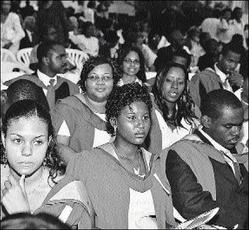
Graduates of the University of the West Indies, Mona campus during the 2005 graduation ceremony. - Photo by Nathaniel Stewart
Being a first-year student at the University of the West Indies can be an intimidating experience. Being outnumbered can be downright frightening.
Malcolm Nelson is a first-year student at the UWI who is studying towards an under-graduate degree in history and is one of a shrinking number of males enrolled at the university and at tertiary institutions in Jamaica as a whole.
Statistics from the UWI show that 82 per cent of the students who were offered places at the institution for this academic year were women. Administrations at local universities are baffled by the yawning disparity between its male and female students and Malcolm is also at a loss as to why so very few men are in institutions of higher learning.
"I did not really think about it before, but now that it has been brought to my attention, it really bothers me that I am part of a minority group," he stated.
Where are our men?

Malcolm Nelson, first-year student at the University of the West Indies. He is among a decreasing number of males matriculating to tertiary institutions. - Peta-Gaye Clachar/Staff Photographer
"It (does) raise some questions of what's happening to our boys and young men, because if they are not here, (at the university), then where are they?" he said, seeming to be genuinely at a loss.
While the nation's educators and Nelson ponder the question, during classes, his face is among the few that are lost in the sea of women, particularly in lectures.
"In large lectures, about 90 per cent of the students are women, however, while they still outnumber us in the smaller groupings of tutorials, the margin is more narrow," he continued.
Dr. Lori-Ann Fisher completed her degree in medicine at UWI earlier this year. Medicine is traditionally a male-dominated field. However, that too has changed. Dr. Fisher, who graduated with first class honours and is one of three graduates being considered as valedictorian for her class, has her own perspective on the issue.
"I think there is more pressure on girls to achieve than on boys. However, boys do face more social pressures than girls, which include the use of marijuana. This is a challenge that fewer girls grapple with," she stated.
According to Dr. Fisher, traditionally, parents enforce stricter rules for girls than boys and boys are allowed to stay out later than girls, even though they might be the same age. She added that parents are more willing to give boys permission to attend certain events, while she and her female relatives and siblings were not given those privileges. She also introduced an interesting twist to the already puzzling phenomenon.
Tradition backfires
"It would appear that the efforts made to correct the imbalance when males dominated certain fields and women were encouraged to hold traditional non-dominant roles, have backfired and what has resulted is the other extreme, where men, instead of women, are now marginalised," Dr. Fisher reasoned.
While Malcolm processes the implications for the low male enrolment at the tertiary level, he revealed that he teaches History and Social Studies at the secondary level and he encourages his male students to make attending university part of their goals.
However, Dr. Fisher is among those who think the disparity reflects a crisis.
"Of the more than 100 students that were in my batch, approximately 70 per cent were females and, even then, the few males faced obvious challenges in meeting up to the rigours of the course," she revealed.
Dr. Fisher said there were even fewer males in the batches that matriculated to UWI after she did.
"It is getting worse each year!" she declared.
The UWI has embarked on a study to determine the cause of male under-achievement levels and what can be done to correct it. The island's tertiary institutions are also working on strategies to attract more males.


















