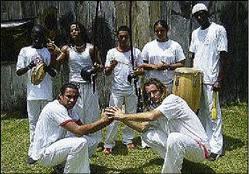
Some of the members of the group. (Back, from left) Paul 'Black Gold' Eathon, Gidson Scantlebury, Felipe 'Fofinho' Oliviera, Christine 'Mandinga' Garcia, Leo 'Esperanca' Francis. (Front) Kareolano 'Carrapeta' Magalhaes, Dennis 'Simpson' Eckart, founder and coordinator. -
Photo by Paul H. Williams
Capoeira has its roots in Central and West African cultures that were brought to Brazil through the Trans-Atlantic slave trade. There are diverse theories about the origins of the art form.
One of the most popular was introduced by çlbano Neves e Sousa in 1965. This theory was subsequently adopted and developed by Lu's da Comara Cascudo in his book, Folclore do Brazil in 1967.
The theory concerns a practice known as 'N'golo', or the Dance of the Zebras. The movements of N'golo mimicked the movements of fighting zebras. The N'golo dance was practised by young warriors competing for the hand of a young woman of marriageable age in a puberty rite known as efundula. The specific group cited by Neves e Sousa was the Mucupe (sometimes spelled Mucope) in Southern Angola. Whoever had a more impressive performance won the bride and was excused from having to pay a dowry.
The 'N'golo theory maintains that in the port of Benguela, and also once in Brazil, the dance developed into a foot-fighting style that was used by both bandits and slaves for defence and attack. The N'golo and its 'cognates' are argued to have been used by Africans and Afro-Brazilians to maintain themselves spiritually and physically under the harsh circumstances of slavery and plantation life. It was developed mainly in three places - Recife, Rio de Janeiro, and the state of Bahia.
While in the first two places, Capoeira was said to be violent, and had no music, in Bahia, it became more of a ritualised game, with a strong musical element.
Dutch invasion
Dutch invasions from 1624-1630 caused temporary disorganisation in the farms and sugar mills of Brazil. For the slaves, these invasions brought an opportunity for escape. Taking advantage of the nearby forests, they hid themselves and formed communities that would become known as Quilombos. They were organised politically and socially like African tribal societies.
When the Dutch were expelled from Brazil the slave owners sent out armed expeditions to recapture the fugitives and destroy the Quilombos. Without a substantial amount of weapons, the ex-slaves realised they would have to defend themselves with their hands and feet. They created a style of self-defence that would stand against weapons and firearms. This style of fighting was called 'Capoeira de Angola'; capoeiras were the name of the brushwoods where the fugitives entrenched themselves and it was believed that the first group of slaves who arrived in Brazil were from Angola.
Outlawed
In 1890, Capoeira was outlawed in Brazil. It remained outside of the law until 1928, when Master Bimba Manoel dos Reis Machado founded what was known as Luta Regional Baiana'. A fusion of Capoeira Angola and batuque (street Capoeira), it was later called Capoeira Regional. During this time, Capoeira became more than just a fight. It achieved national recognition and became what it is today - a dance, a sport, a game and an artistic expression of freedom.
Sources: http://en.wikipedia.org/wiki/Capoeira_Angola
http://www.capoeirista.com/history_1_1.html