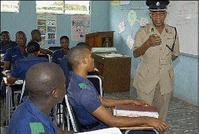
Assistant Commissioner of Police in Charge of Training Delworth Heath (standing) conducts a training session with recruits at the Police Academy in Twickenham Park. - Contributed
Jamaica is one of three countries in the world with excessively high murder rates - 51 murders per 100,000 people. As the country tries to find solutions to this problem, the question of adequate training arises.
Upon entry into the force, all recruits are trained rigorously in the use of force. The controlled environs of training at the Police Academy are, however, far removed from the realities of the world waiting for them on the outside.
"Every policeman is retrained (on a yearly basis) and recertified in the use of a firearm. It means that they must go through a period of training on the rules of engagement - when do you fire, when should you not fire and how to use your weapon. The unfortunate thing is when you get out there, it is as if the entire thing changes, because now, you are no longer in the controlled environment of training ... and so, more or less, here is this thing. The survival instinct of the human being takes over," explains Superintendent Yvonne Martin-Daley of the police training branch.
Use-of-force policy
In addition to training, all cops are supplied with a booklet outlining the police use-of-force policy. If they are, in fact, involved in a case of excessive force, then they are removed from front-line duty, counselled, and where the need for retraining is determined necessary, it is done.
"There are people who believe the training to get into the force is substandard. It's not true. We've had people from universities with degrees who come here and do not do well," Martin-Daley responds in defense of criticism that recruitment is below standard.
"We have people with all levels of education and what we are looking for are people with broad-based levels of education who can maintain that level of life-long learning. We are trying to change that [all these negative things said about our training] in terms of the standards that we bring to training," says Martin-Daley.
Before recruitment to the constabulary, candidates must go through a number of tests which include psychological, language proficiency and drug tests, as well as rigorous training in the laws of the country, ethics and sociology. They also do practical policing once they are near the completion of training.
"There are weaknesses in the system because we sometimes find that people come with ulterior motives and you do everything you can, but it's the human thing that comes out sometimes. So, when they are in training, you see the best person.
"We are just asking for the public, as well as the supervisors, to play their role to keep the policemen on the straight and narrow because it is rough out there," Martin-Daley says.
- Gareth Manning
SOME HIGH PROFILE CASES OF POLICE EXCESSES Michael Gayle (1999):
On August 21,1999, Michael Gayle, a mentally ill man, was beaten severely by police and soldiers in Olympic Gardens. He succumbed to his injuries two days later, in the Kingston Public Hospital. After filing a suit against the Government in the Supreme Court, his mother, Janine Cameron, was awarded $2.7 million, five years later.
Janice Allen (2000):
In April 2000, 13-year-old Janice Allen was shot dead at her gate in Trench Town, Kingston, allegedly by police. In March 2004, the officer charged with her murder was freed in the Portland Circuit Court. The jury was directed to return a formal verdict of not guilty after the court was informed that a policeman who was a vital witness in the case was off the island and was not returning. It later turned out that the information was false.
Her mother, Millicent Forbes, who is backed by the lobby group Jamaicans For Justice, has been trying, since then, to have the jury's verdict set aside so that there can be a retrial. The Court of Appeal, in dismissing Forbes' appeal in December 2006, upheld a ruling by the Judicial Review Court that the acquittal was not open to judicial review. The court then called for urgent legislation to be passed to deal with tainted acquittals.
In February, her mother took the appeal to the Privy Council in the United Kingdom.
David Bacchas and Cecil Brown (2003):
On October 18, 2003, 63-year-old taxi driver, David Bacchas, and his passenger, 65-year-old, Cecil Brown, were killed, allegedly by police, as they drove in a motor car in Flankers, Montego Bay, St. James. Five police officers were charged with the double murder, as well as wounding with intent. They were freed in July 2006. However, in 2006, a settlement was reached between the Government and the estate of the two men. Bacchas' family was awarded $4.75 million in January of last year.
Kraal (2003):
Angela Richards, 45, Lewena Thompson, Kirk Gordon and Matthew James, both 29, were allegedly killed by members of the Crime Management Unit on Thursday, May 8, 2003, in a house owned by Richards in Kraal, Clarendon. Four policemen, including one senior officer, were charged with the murder of the four but were later acquitted in December 2005 by a 12-member jury.


















