Errol Hewitt, Contributor
Hewitt
"You were running the race nobly. Who has hindered and stopped you from obeying and following the truth?" Galatians 5:7
The post-election period so far has been regrettably marked by an ongoing division between our people, seemingly fanned by the unflinchingly flaming rhetoric of some, the unaccustomed circumstance of others and 'constitutional issues'. Our country needs stability urgently and to ensure this, these constitutional issues and their offshoots ought maturely and responsibly to have been settled in Parliament. The remaining option means months of instability which the country can ill afford.
Hopefully, the realisation that it is the 'post-election' period and the gravity of our fiscal situation will soon assert itself and as a people, we will set about soberly addressing the nation's business. Our new Prime Minister has correctly adopted a statesman-like approach, and with a fully stocked 'Cabinet', it must be that management of government will not be a problem.
As well-'stocked' as the Cabinet is, however, it must work through the public service; but how well prepared is that body to confront the challenges before us?
Because of its size, Jamaica is known internationally as a 'land of samples', meaning that our natural resources are com-paratively minimal. Certainly, the St. Catherine gold rush has 'panned out' and the oil wells have not yet gushed. It is, therefore, indisputable that our people are our best asset and therefore the key to countrywide development. Such development must depend on a workforce which is appropriately educated and trained, with - and this is crucial but so far regularly overlooked - a bias in areas which will provide the best opportunities for socioeconomic progress and the full realisation of our people's potential, i.e., their individual creativity and in-novativeness. This 'bias' in the orientation of education would be a major step forward in more pointedly linking education with real job op-portunities and contribute towards adjusting the current gender imbalance in many tertiary institutions.
The manifestos of the political parties are really a 'wish list' i.e., "If I had the funds, this is what I would do", and as this election was two years in the making, it is hoped that this new Government would have the draft framework of a national plan ready, only waiting their settling into office to be finalised. This, assuming support from the Opposition, would go a far way both in influencing the orientation of our approach in more pointedly structuring education and importantly, in guiding the restructuring of the public service - ensuring that it is configured specifically to accomplish its task. But in this state of political instability, how far can any positive action be taken?
More form than substance
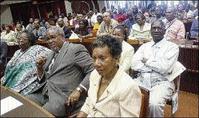
Can civil servants function in a state of instability? - Contributed
Development must be advanced regardless, and that effort must proceed through the public service, the 'tool' in Government's hands. And in what shape is that body?
It has been generally agreed by successive administrations that the size of the public service is much too large - especially the ministries and their agencies costing almost 40 per cent of total revenue - but given the political considerations, the results in terms of resizing, have over time, been nothing more than 'paring' exercises.
It seems obvious that past restructuring exercises were more in form than substance, as evidenced for example, in the wave of statutory agencies for which financial self-sufficiency is trumpeted as the index of success. Yet, disingenuously, the majority of these entities are really monopolies which the public is compelled to use. This is an affront to the public, faced in many agencies with high fees and unsatisfactory service from their now be-suited officers.
The Lands Department provides a prime example where the processing of applications - many as a base for economic activity - are more measurable in months, and in some cases, even years. The events last year involving the Titles Department and its director indicate how poorly supervised entities become feudalistic in their operations, to the detriment of the public, even as they brought joy to government's heart by being financially self-sufficient.
Jamaica's public sector had an enviable reputation among develop-ment agencies around the world, especially during the first two decades of Independence, when it accomplished the country's smooth transition into administrative and political independence. This it did with a staff that had the character, training and commitment to plan comprehensively such an operation and lay a foundation from which to base future improvements. In time, as Government became more complex, international development institutions in the latter half of the 1970s recommended the need for reforming and restructuring the public service to make it more relevant to its changing task. For the next 30 years we have been having almost continuous public sector reform programmes, to the point where the unit responsible has ironically been institutionalised. Yet the urgency of the need persists. Understandably, they were without the benefit of a national plan outlining the social and economic goals of the country and steering the reform of the public service in order to attain these goals. As such, many of these exercises were not properly directed, structured or specific to current and future needs.
The consequence
The consequence of all this on the public service was neither a proper focus nor sense of purpose, evidencing both falling standards and levels of commitment. Parallel to this was the entrenching of an ascriptive culture which fosters 'connections' - who you know and who knows you - over merit and achievement. In general, this in turn, inculcated a type of feudalistic culture marked by a frenzied determination to defend posts, opportunities and 'insiders', which, despite being white collar, assimilates the protectionist trend of the community dons and donnettes.
Further, all serious decisions and activities revolve around the same clique of influential persons, irrespective of relevance of expertise, experience or personal 'special interest'. All this is a fertile ground for corruption - a fact reflected in our continuing fall in the international ratings for corruption.
Talented persons in the service - including young bright graduates - have an unspoken choice of either complying by silently carrying others on their shoulders, in time absorbing the culture, or silently moving on, many to the U.S.A., but increasingly to Southern Africa, Dubai, etc., and doing well wherever merit is rewarded.
This pattern has percolated through much of the public service despite the efforts of some. For these administrative dons and donnettes, it doesn't matter if they are unsuitable for the job or the jobs are not being done well - no one seems to be looking or actively supervising anyhow. Maintaining 'power' and position is the goal and in many cases, the only goal. And this culture seems infectious as it can be identified in many other areas nationally, including in several of our leading and even regional sports, etc. - standards falling because of the shortfalls of suffocatingly dominant and visionless leaders at many levels.
Change management is embryonic but even so, the present structure and culture, unless addressed, will smother such attempts.
Surely the aim must be productive jobs. Not 'jobs for jobs sake' as is regrettably the case for much of the service with its bloated numbers, low productivity, enormous demands on the public purse and a poor record as an employer.
We are a poor country with an innovative and creative people whose abilities must be productively utilised instead of tied in obeisance to an ascriptive 'don't rock the boat' culture or suffer the civil service dons/donnettes' AK47 pen, which is administratively equally violent, equally deadly as the feared assault rifle.
Fighting weight
To succeed on our behalf, this 'tool' of Government - the public service - has to be refashioned, transformed and honed sensibly to expect it to meet the specifics of realistic national goals and downsized to a real 'fighting' weight.
A central element of all this must be the ensuring of authentic options for the unemployed as well as the displaced. In this regard, it is crucial that another look is taken at improving the incentives needed to foster small businesses seriously, by placing it on a firm foundation, with adequate support in concessionary funding, advisory support [including perhaps a league of retired experts], expansion of existing facilitatory agencies, and real practical help in marketing. The possibilities and potential of small business to the socioeconomic development of our country is enormous, particularly so for the young, innovative and industrious, as well as in generating jobs.
The aim of Government must be that every individual in our society has a sense of purpose, a realisation of potential a sense of self-worth, and be able to positively contribute to the nation, instead of a meandering existence where 'holding your corner' is your best if not only, option.
To accomplish all this, we need a capable and visionary government, supported by an affordable and efficient public service.
"When the brothers fight to the death, a stranger inherits their father's estate". [Ibo proverb.]
Errol Hewitt is an information and communication technology planning consultant with the United Nations and the Commonwealth Secretariat. He may be contacted at estahewitt@yahoo.com