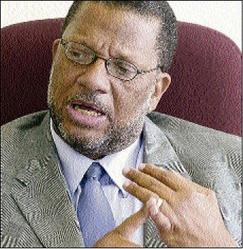
Phillips: I approach life each day trying to figure out how best I can make a contribution to the improvement of life for the country and for the people in it. I certainly am not seeking any vain glory for myself. -
Ricardo Makyn/Staff Photographer
On page A3 of the Gleaner print (lead section online), we carried a story in which Dr. Peter Phillips, a former minister in the last government, spoke of his intention to remain vocal in opposition.
In this feature, we present excerpts from his interview with Senior Gleaner Writer Earl Moxam.
The Gleaner: Dr. Phillips, Jamaica has just come out of a general election in which your People's National Party (PNP) lost after being in office for 18 years. Reflecting on those years in office, what were the things that went well and the things that didn't go so well?
Phillips: The 18 years have seen a substantial transformation of Jamaica for the better. Obviously, it wasn't perfect, but we can point to more people having better educational opportunities, better housing, more people with jobs and better prospects for the ordinary Jamaican. Most significantly, I think of the very difficult decision back in September 1991, which saw the liberalisation of the dollar which was an essential task that had to be accomplished in a globalised world. There was also the removal of price controls, particularly in relation to petroleum, as well as other products. The administration also brought Jamaica firmly into the modern world of the market and at the same time remained true to its commitments to the upliftment of people who have been disadvantaged and to dealing with the enduring problem of poverty and discrimination.
Given the socialist legacy of the PNP from the 1970s, I recall Michael Manley saying in an interview with me that he didn't think there was anybody else who could have convinced the party and the Government (upon the PNP's return to office in 1989) that these changes needed to be made against the background of what the party used to enunciate. How difficult was it back then in the councils of the Government and the party?
PP: It was a difficult set of decisions. There were those - admittedly a minority - who were wedded to the past of controls and central direction. There were those who argued that, yes, it was the right direction to go into in terms of liberalising the economy but that it was too quick. I think it is true to say that were it not for the tremendous intellectual gifts and stature of Michael Manley at the time, it probably would not have happened. But it was very clear, intellectually, that, in a globalised and increasingly integrated economy, Jamaica was just too small to remain aside and try to maintain these fences around our own domestic economy; that the future really rested in opening up the economy and in allowing market forces to work. What gave him (Manley) particular concern was how to remain faithful to our history and to the antecedents of the movement, which really embodied a commitment to greater equality, of sharing of political decision making among the mass of the population and access to social mobility for the majority who had been kept down over the long years of our history.
After 18 years in Government, you now find yourself in Opposition. You had aspirations to lead the PNP, which floundered at the last attempt. What of your plans now that the PNP is back in Opposition?
The plans are to first of all participate in the process of appraisal and reevaluation that we must undertake. My contribution, for the greater part of my adult life, has been towards trying to ensure that we maintain the People's National Party as a viable instrument of national development; to ensure that we remain faithful to the traditions and principles and philosophical objectives of the founders and the generations of Jamaicans who have dedicated their lives to the party; and to ensure that we can maintain it as an effective instrument to be handed on to generations that come after us.
Some of your admirers are arguing that you are the person best able to lead that process, as president of the PNP. Would you again challenge for the leadership?
The issue doesn't arise at this point, at all. I have always said that I don't wake up every day saying that I want to be in this position or that position. I've always asked how best I can make a contribution to the party. There is now not an issue of leadership to challenge. There are people all about in the society and some in the party who are wagging their tongues, but, quite honestly, that's not how I approach life. I approach life each day trying to figure out how best I can make a contribution to the improvement of life for the country and for the people in it. I certainly am not seeking any vain glory for myself.
Some might argue that there is only a small window of opportunity for the PNP to retool in Opposition to prepare for the next election and therefore it has to settle the issue as to who is best able to lead it into the next election. Has that matter been settled?
Well, the party is a collective and the party as a whole is going to have to take stock of where it wants to go and what it wants to do; it's not about me.
Would you be open to others approaching you to encourage you to offer yourself in the future if the need arises?
Sufficient unto the day. Those are hypothetical issues that I won't contemplate. I've always been willing to make a contribution where the collective thinks such a contribution can be made.
Yet, I'm still hearing of a Phillips camp and a Simpson Miller camp in the party.
Well, we don't have any camp, as such. There are people who were supportive of me during the presidential bid. Many of them remain in touch and we discuss views, but there is no camp in the sense that there is any organisation and coordination of views.
Would you say though that those who supported you would be awaiting a signal from you as to how they proceed in terms of party activities and unity?
The most important thing for all of us to do is to preserve the very unity that you spoke of. The People's National Party is an important instrument of national development and we need to ensure that it remains so.


















