
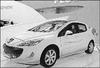
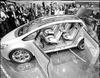
(Left)A man inspects the GM Chevrolet Volt at the 62nd International Auto Show in Frankfurt, Germany, on Wednesday, September 12. The GM Volt is a low-emission concept car and is electrically powered. A second engine is onboard to produce additional energy and to extend the car's operating range. (Middle) the new Peugeot 308 hybrid is seen at the 62nd international Auto show in Frankfurt, Germany.
(Right) An Opel Flextreme electric car that runs a distance of 55 km is seen at the car show. The 62th IAA automobile show opened its doors to the public from September 15 through to September 23. -AP photos
FRANKFURT, Germany (AP):
Automakers seeking to go green are facing an array of choices and technology, from ion-lithium batteries coupled with diesel engines to hydrogen and natural gas - but what's popular in one place is dismissed in another.
Manufacturers and analysts say the more choices there are to make cars less polluting the better, because ultimately it means consumers and the environment will benefit. "You would think they would like a standardisation of powertrain globally," said Jack Nerad, executive market analyst for Kelley Blue Book in Irvine, California. But, until they have that, "everybody's looking for that competitive advantage and nobody wants to be on the wrong side of the green movement."
Hybrids have taken the public's fancy in the U.S., led in part by Toyota Motor Corp.'s Prius, which has become the poster car for cleaner emissions. In Europe, though, hybrids have been slower to catch on in part because automakers have long embraced the use of diesel, which burns cleaner and emits fewer pollutants than unleaded gasolene. It's a split likely to continue given the research being done by Volkswagen AG and DaimlerChrysler AG, among others, into the use of diesel to make engines more efficient and reduce emissions.
Olivier Rabiller, vice-president for customer management at Honeywell Turbo Technologies' passenger vehicles unit, said his company has been working with Volkswagen to improve diesel engines and their performance. Consumers in Europe have grown used to the fact that buying a diesel-powered car means lower emissions because it also provides more torque and, thus, more power, especially when the engines are turbodiesels.
"We are used to seeing the Germans really pushing in that direction, but not (just them) any longer," he told The Associated Press. "Others have announced they would use diesel to help save fuel, too. It is a very strong message to the industry."
Dozens of cars - both production and concept - were unveiled at the Frankfurt auto show with new forms of propulsion that are environmental in nature. Volkswagen had five models, along with a version of its mainstay Golf, that used refinements it called BlueMotion to reduce emissions to 119 grams per kilometre (4.2 ounces for just slightly more than every half mile) from 135 grams (4.7 ounces).
Erich Merkle, vice-president of forecasting for consulting company IRN Inc. in Grand Rapids, Michigan, said U.S. buyers tend to favour hybrids because there's a premium on diesels in the United States. "Hybrids are a global phenomenon. If Europe is going to maintain its competitive posture here in the States, they've got to have a hybrid option," he said. "They are heavily dependent on the U.S. market. It would be really short-sighted to not pursue it."
They are. Porsche AG showed off a version of its Cayenne sport utility vehicle that is powered by hybrid technology developed with Volkswagen, and BMW pulled back the curtain on its X6, an SUV coupe crossover hybrid.
GM showed off its Flextreme from European subsidiary Opel, a small commuter car with an electric-diesel hybrid that can travel 55 kilometres, or 34 miles, on a single charge before switching to fuel. It is a concept car, meaning it may or may not go into production. The Flextreme uses a battery to produce no emissions directly - and packs a small turbo-diesel engine for when the juice runs dry.
The options are plentiful, said GM Europe President Carl-Peter Forster, who said that consumers would see "a competition of various technologies and, ultimately, the one that best suits the needs" would win.