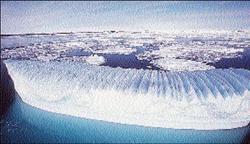
An iceberg floats in Australian Antarctic Territory. Scientists argue that climate change and the depletion of the ozone layer will trigger further melting in the world's polar regions. - Reuters GENEVA, Switzerland (Reuters):
A hole in the ozone layer over Antarctica has appeared earlier than usual in 2007, the United Nations weather agency said yesterday.
The World Meteorological Organisation (WMO) said it would not be clear for several weeks whether the ozone hole, which is expected to continue growing until early October, would be larger than its record size in 2006.
"It is still too early to give a definitive statement about the development of this year's ozone hole and the degree of ozone loss that will occur. This will, to a large extent, depend on the meteorological conditions," the Geneva-based agency said.
The ozone layer shields the earth from damaging ultra-violet rays that can cause skin cancer.
While use of ozone-depleting chlorofluorocarbons has waned, the WMO said large amounts of chlorine and bromine remain in the atmosphere and would likely keep causing holes in the protective layer for years to come.
Ozone-depleting substances
"Although ozone-depleting substances are now declining slowly, there is no sign that the Antarctic ozone hole is getting smaller," it said in a report.
The WMO and the U.N. Environment Programme have said the ozone layer would likely return to pre-1980 levels by 2049 over much of Europe, North America, Asia, Australasia, Latin America and Africa. But in Antarctica, the agencies said, ozone layer recovery would likely be delayed until 2065.
Geir Braathen, a senior scientific officer with the WMO's atmospheric research and environment programme, said the ozone hole may reach the southern tip of South America in 2007.


















