
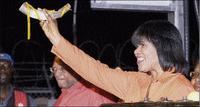
People's National Party (PNP) president Portia Simpson Miller holds aloft an abeng, a symbolic instrument of the Maroons, at a PNP mass rally at Portia Simpson Miller Square, recently. - Colin Hamilton/Freelance PhotographerFirst, a disclaimer. Many of you have followed us over the last week as we are engrossed in the exercise of looking at the Jamaica Labour Party's (JLP) and the People's National Party's (PNP) manifesto, weighing them fairly in the balance to find out where these documents are substantial and where they are wanting.
The purpose of the exercise has not been to wave either a green or an orange flag, but rather to lay out before voters, in an accessible manner, what the costs and likely benefits of their policy proposals are. In other words, what kind of Jamaica can we reasonably expect to be built from the blueprint of these two manifestos?
Every action, of course, has a trade-off, and candidates for public office have not traditionally been forthcoming with prospective voters about what those trade-offs are likely to be.
The budgetary cost is one such, and last week Sunday, we began running the 'thermometer' included in Sunday's article, which adds up the costs of pledges made in the party manifestos so far.
Now, one would never want to judge a party platform on the basis of its cost alone. Public spending can, when done well, yield great returns, and penny-pinching a public sector out of existence is a real danger.
Still, using what we consider a very optimistic projection for growth - starting at three per cent next year and rising gradually to five per cent by the fifth year - a sustained rate which one should note no Jamaican government has actually maintained since the 1960s - we estimated what future revenue is likely to be.
Figures not perfect

So, all things being equal, we are adjudging what proportion of this new hopeful money has already been committed by the parties. It will be important to see whether either party 'bursts' the thermo-meter in this season of grand pledging, because having covered only two - crime and job-creation - of the six issues we are surveying so far, we can see the temperature has already started to rise.
Another disclaimer. Estimating the cost party promises is a painstaking exercise, involving many charts, graphs, tables, calculations, cross-referencing and interpretation. One must therefore note at the outset that while the figures shown in the thermometer represent more than just intelligent guess work, they are not perfect.
Indeed, CaPRI welcomes input from all those who can assist us to come up with an even clearer picture of the real cost of government programmes. In particular, we urge the parties to share with us their own research, and we will revise our own findings accordingly. In the meantime, our estimations which we have made using a conservative methodology, are to be treated as only a minimum cost of promises.
Today, we turn our attention to the third issue area, which is governance.
It will be a relief to prudent-minded readers to know that governance is an area in which neither party is making proposals likely to send us to the poorhouse. While the JLP's wish list for the economy appears to carry a very high price tag, its wish list for governance, changes is relatively inexpensive, though still ambitious. This is significant.
CaPRI's content analysis suggests that governance may be the most important issue for the JLP, given both the breadth and apparent depth of treatment the topic receives in their manifesto. Recent scholarship in economics underscores the importance of good institutions of governance to prosperity.
By contrast, the PNP's governance agenda is not particularly bold. Headlining it, is a proposal to follow the leads of Guyana and Trinidad and become a full republic. While this severing of judicial ties with England may be symbolically important for Jamaica, a republican status will have very little impact on the relationship between citizens and their State, and virtually no impact at all on the legislative process.
Beyond that, the PNP makes only modest recommendations to government structures.
The JLP, on the other hand, presents a long and ambitious list of proposals which, if fully implemented, could produce the most significant changes seen in the Jamaican State in a long time. Among the changes which CaPRI's research suggests could prove significant would be creating a special prosecutor to combat corruption, strengthening existing anti-corruption authorities, regulating party funding and reforming the libel and slander laws, which would enable the media to investigate and report on corruption more aggressively.
The creation of independent investigative bodies have no real authority if they are not endowed with sanctioning power. The JLP also wants to strengthen Parliament and reduce the discretionary power of the Prime Minister, notably in the calling of elections and public appointments.
Such proposals could fundamentall the relationship between citizen and state by strengthening Parliament and making government more accountable.
Interestingly, while the police force gets obvious special attention in both manifestos' treatment on crime, it gets very little in their treatment of governance and corruption. CaPRI's research indicates, however, that the police force is the single most mistrusted public institution in Jamaica.
Owing to this lack of trust in the State's conflict-settlement mechanisms (police and courts), citizens have resorted to settling many of their differences in extra-legal means. Governance reform which does not convince people of an honest determination to root out police corruption will not restore trust in the force or the Government as a whole.
With the likes of Bustamante, Seaga and the Manleys, Jamaica has had a tradition of dominant leaders. Some might argue that recent years have augured a move away from a charismatic centre and the Labour Party's proposals certainly would formalise that process.
Still, it is worth noting - all hubris about Jamaica being one of only two island-continents in the world set aside - Jamaica is in fact a small country. To an extent, the experience of Jamaica has shown that political support counts for a great deal.
Our research has shown that where anti-corruption initiatives have failed it was due to a lack of competence on the part of officials, a lack of political will.
It seems reasonable to conclude that for corruption to truly be flushed out of the Jamaican system, a public and verifiable commitment at the highest level - which is to say, from the leaders of the two parties - to provide full backing to anti-corruption initiatives is essential.
It is no longer sufficient for party leaders to say 'trust me'. They must give voters a commitment that can be measured and reported on after the election, setting clear goals and measures - ideally, a plan of action that specifies when measures promised in the manifestos will be implemented, with a reporting mechanism, possibly by an anti-corruption 'czar' or recognised watchdog. This might then convince the citizenry that the manifestos offer more than wish.
In last week's publication, we inadvertently said Stocks and Securities Ltd. was owned by Pan Caribbean Financial Services Ltd. This is incorrect. Stocks and Securities Ltd. is an independent stock brokerage. We regret the error.