Keith Collister, Business Writer
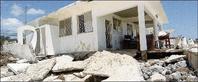
A house on the beach in Long Bay, Portland on Tuesday that was damaged during the passage of Hurricane Dean. - Ricardo Makyn/Staff Photographer
The official estimates of the damage wrought by Hurricane Dean are not yet completed, but already the operators of the Caribbean Catastrophe Risk Insurance Facility (CCRIF) have determined that Jamaica stands to get no benefit from the insurance.
According to Dr. Simon Young, chief executive officer of Caribbean Risk Managers Limited (CariRM), Hurricane Dean was not severe enough to qualify Jamaica to draw down funds from the facility.
While this was only a preliminary assessment, in that the "data had not yet been verified by a third party", it was "not going to change", Dr. Young told Wednesday Business.
Efforts to get confirmation from the Ministry of Finance yesterday were unsuccessful.
Jamaica paid a US$4 million premium for US$94.4 million (J$6.5 billion) of insurance coverage for hurricane and earthquake damage under the CCRIF. This was split between US$50 million ($3.4 billion) for hurricane damage and US$44.4 million ($3 billion) for earthquakes.
Disaster risk financing arrangements
The CCRIF was set up after Caribbean Community (CARICOM) member states asked the World Bank for assistance in gaining access to affordable and effective disaster risk financing arrangements following the devastation caused by natural disasters in the Caribbean in 2004.
In response, the World Bank developed the CCRIF. It allows 18 Caribbean countries to pool natural disaster risks, reducing their cost of insurance by 40 per cent. It ensures swift payment of claims with coverage similar to business interruption insurance. The speed at which claim payments are processed makes the instrument particularly useful for financing immediate post-disaster recovery needs, while the affected country seeks funds from other sources for longer-term reconstruction.
CariRM, whichis part of the CGM Group, is the operator of the CCRIF, the first ever multicountry catastrophe insurance pool worldwide. The CGM group is a regional business with interests in Jamaica, Barbados and St. Vincent. The company is chaired by Jamaican businessman, Joseph M. Matalon.
Payouts
According to Dr. Young, insurance payouts are determined parametri-cally, meaning that they are not conditional on data to be collected on the specific losses in a country, but are instead triggered by the intensity of the event, such as winds exceeding a certain speed.
The data for the calculations are obtained from official reporting agencies such as the United States-based National Hurricane Center.
At the request of Caribbean Governments, the CCRIF was specifically designed to provide coverage for severe catastrophes or "real catastrophes" as Dr. Young puts it.
He pointed out that the CCRIF was operated like a trust fund, whose beneficiaries were the participating Caribbean countries. If no money is paid out, for example as a result of 'Dean' missing Jamaica, this does not benefit anybody other than the trust beneficiaries, as the money simply stays in the trust to meet future events.
keithcollister@cwjamaica.com