Karlene O'Connor, Gleaner Writer

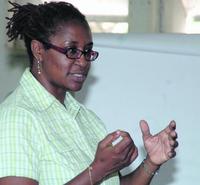
Althea Bailey
Between stolen sips of a hot beverage she remembers that she is out of condoms, not for her personal use, but for the group that will be making its presentation in a little while from now. With a quick call to the health centre, she makes arrangements to pick up a box. With everything in place for the presentation, she is able to relax for a few minutes.
Sitting at her desk, in her office located on the campus of the University of the West Indies (UWI) Bailey, attired in a fashionably cut beige pantsuit, steals another sip from her cup of tea. She did this while rummaging through her desk drawer searching for documents in preparation for the presentation, in the inner-city community of Grants Pen, St. Andrew.
Bailey is a lecturer in the Department of Community Health and Psychiatry at the UWI and a woman who wears many hats. Her expertise in the field of communication, coupled with her commitment to combating HIV/AIDS, has led to her spearheading and participating in numerous behaviour change programmes in communities in Kingston and St. Andrew and St. Catherine. These programmes generally include sensitising and training persons about issues related to HIV/AIDS. Her work in the inner-city also includes research done within some of these communities and among high risk groups, namely teenagers and commercial sex workers.
But how did this self-styled tomboy, who grew up in some of Kingston's most notorious inner-city communities, find herself in such a position today?
"None of this was planned," she said, adding that, "It is just where my life has led me. I am an optimist and believe things will work out in the end, no matter how bad they seem."
Call it divine intervention or chalk it up toa love for human life, but Bailey, 47, has spent more than half of her life guiding others with her work in behaviour change communication accounting for at least 20 of those years.
It began in 1987 when she worked as a liaison information and communication officer at the National Family Planning Board. Since then, she has worked as a project manager for the Association for the Control of Sexually Transmitted Diseases (ACOSTRAD) Jamaica and, among other roles, as a behaviour change communication programme manager, National HIV/STI Control Programme in the Ministry of Health.
"I came into HIV with a passion to help people and I now realise that the key thing is to make a difference," she explained. She notes that the stigma attached to HIV/AIDS is much reduced now, moreso than in the early 1990s when she first entered the field. She adds however that she cannot share in the glory of the early successes of communication interventions as stalwarts, including Dr. Peter Figueroa, chief of epidemiology and AIDS in the Ministry of Health, and Dr. Peter Weller, clinical psychologist and lecturer, UWI, have been working assiduously to make the interventions reap success.
Ghetto education
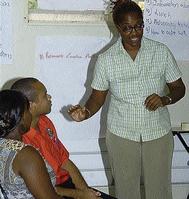
Althea Bailey in one of her classes at the University of the West Indies. - photos by Winston Sill/Freelance Photographer
A pure-blooded Kingstonian from Waterhouse, Gretna Green Avenue and Vineyard Town are some of the communities she has called home.
"A ghetto education is basic," according to Damian 'Junior Gong' Marley's hit song Welcome to Jamrock, and Bailey credits this in helping to guide her understanding of people's behaviour.
It is this knowledge of other peoples' pain and struggle to survive to which she attributes her dedication to behaviour change communication.
"Behaviour is not a black and white issue, change is complicated and it is not easy for someone to change who they are," she said while notingthat people are today much more aware that HIV can happen when people are sexually active and not thinking about the things that they are doing.
"Sex workers are more aware," she continues, "the behaviour change is not as you wish it to be, but being able to work with people who are marginalised and make them see that their lives are important makes all the difference."
But where was Ms. Bailey educated?
'Chequered' is the word she uses to describe her early school life. This, she explained, was due in part to her family's frequent relocation.
Most of her early education was received at Mountain View Primary, from where she moved to Excelsior High. From there, she moved on to Shortwood Teachers College where she attained a certificate in secondary education. While working as a teacher at St. Annes High, located in Hannah Town in west Kingston, Ms. Bailey decided to pursue a degree at the UWI. This she did studying part-time.
"It was the time of free education or I would not have been able to afford it otherwise," she told The Gleaner.
COMMUNITY WORK
Bailey was thrice awarded for her work in community service by different organisations, namely the National AIDS Committee; the St. Catherine Parish AIDS Committee and the National HIV/AIDS Programme. Just in case the cadre of young minds that have benefited from the programmes she piloted forgot to say so, Dwayne Henry of the UWI's Student CARE programme sums it all up when he states that "She is one of the best in her field, without a doubt."
That sentiment is shared by Ann-Marie Dobson, director of public education, at the Jamaica AIDS Support, a local non-governmental organisation responding to the needs of persons living with HIV/AIDS, where Bailey has served for five years as a board member.
"She understands the issues of HIV, and delivers them well, and that is why it is so easy to call on her whenever anyone has to do a presentation," says Dobson, adding that "she is not aloof or anything like that, everybody thinks she is so easy to talk to. I have known her for a year and it feels like a million years."
The UWI HIV/AIDS Response Programme (UWIHARP), an organisation that uses the expertise available on all of the campuses to work with committed partners in combating HIV/AIDS, and the Rotary Club are the organisations through which she was introduced to the Stella Maris Foundation (SMF), in Grants Pen, St. Andrew. There, Ms. Bailey conducted training sessions on the awareness of HIV/AIDS, with members of the Youth Crime Watch Group over a two-month period.
Grants Pen, that is described as a work in progress, is but one inner-city community where Bailey has conducted training. She listed Rivoli, Tawes Pen and Gordon Pen, all of Spanish Town, St. Catherine and Majesty Gardens and Gully Bank, of the Corporate Area among places she has worked, implementing HIV/AIDS programmes.
Normal lives
With clarity, she recalls the first time she told someone they were HIV positive. "He broke down. In those days HIV was regarded as a death sentence. Today people are more aware, they know that they have some level of control and can live normal lives."
She commends what she calls the progress in public education, noting it as "a great sense of achievement, much more than money could buy". However, her vision in the fight against HIV remains: "Apart from finding a cure, I would try to reduce people's risk by improving social conditions. Poverty influences people's behaviour, it puts people at risk. Gender is also an issue. I would definitely reduce vulnerability due to poverty."
So, should you bump into this university lecturer and mother of two the next time you visit a go-go club, or, should you pass her at some sinister corner chatting up some young men, don't be alarmed - she is not considering a change of career, instea Bailey goes where her career takes her.


















