Tony Deyal Howard Cossell, of whom Muhammad Ali once said, "Sometimes Howard makes me wish I was a dog and he was a fireplug," told it as it is when he observed, "There are two professions that one can be hired at with little experience. One is prostitution. The other is sports-casting. Too frequently they become the same."
There has only been one known exception to the Cossell conundrum. His name was John Arlott. While applied to the vast majority of its practitioners, the term 'sports journalist' is an oxymoron, for Arlottit was not. He was a connoisseur of wine, a writer of poetry and a commentator on cricket. He was also The Guardian's chief cricket correspondent from 1968-1980 and wrote biographies of Fred Trueman and Maurice Tate.
First meeting
Bill Frindall, the scorer for 'Test Match Special', the BBC programme that revolved around Arlott for 34 years, described his first meeting with Arlott. "We were introduced and John immediately tried to put me at ease. His first words to me were, 'Hello. Welcome. What do you give the woman who has everything?' The scene was a cramped, ramshackle eyrie, set on stilts overlooking a rain-swept cricket ground at Worcester. Even months of meticulous research and a dawn arrival for my first cricket broadcast had not prepared me for such a question. 'Encouragement?' I ventured, helplessly. 'No,' he growled triumphantly. 'Penicillin.' My dismay at failing to answer such an obvious riddle was swiftly removed by the great man's next remarks. 'I hear you like driving. Well, I like drinking. We're going to get on well.'"
Arlott got his big break when in 1945 as a police sergeant in Hampshire he made the Victory Day broadcast to the Queen. He got to meet many people behind the scenes at the BBC, and helped by the poet John Betjeman who liked his work, Arlott became overseas literary producer and then was asked to be a commentator on the first two matches of the Indian tour of 1946. These went so well that he was asked to continue to broadcast the whole series. From then on, according to one tribute to him, "the public had begun to take note of a new and utterly individual voice coming over the air describing cricket. In the war, the voice of Churchill had been a symbol of defiance, rousing ordinary folk to great deeds. Now the voice of Arlott brought comfort and reassurance as they adjusted to the ways of peace. His commentary technique was strongly influenced by his poetic sense. With the economy of a poet, he could describe a piece of play without fuss or over-elaboration, being always conscious of its rhythm and mindful of its background. He was never repetitive or monotonous, except for effect. The listener's imagination was given free rein."
During the first Cricket World Cup in 1975, Arlott described, in pure poetry, a shot by a West Indian genius, "Clive Lloyd hits him high over midwicket for a four, a stroke of a man knocking a thistle top with a walking stick." When Botham hit a particularly scorching shot, "None but the brave deserves the four." One of Arlott's most memorable quotes came when there was a streaker at Lord's in a 1975 Test match between England and the West Indies, "We have got a freaker down the wicket now, he's masculine, well-built, wearing plimsols, and I'm sure if his mother's watching television, she'll recognise him, not very shapely as it is masculine, and I would think it has seen the last of its cricket for the day ... he has had his load, he is being embraced by a blond policeman and this may well be his last public appearance - but what a splendid one!" I was unfortunate not to hear his comments on a female who also streaked that particular game and, to my mind, the better of the two.
Only Arlott could have come up with, "The fieldsmen are scattered in the wilderness like missionaries" or "Lillee is wearing a voluminous nightshirt which would have room for another man if he could get into the trousers". Arlott said of another outstanding (and eccentric) Englishman, "Umpire Harold Bird having a wonderful time, signalling everything in the world, including stopping traffic coming on from behind." Bird had said of himself, "If there were an Olympic event for running backwards I would be the obvious favourite."
Classic commentaries
There are many others - Asif Masood, the Pakistani fast bowler, who "approaches the wicket like Groucho Marx chasing a pretty waitress", and Keith Miller being "like a cross between a Viking and an irresponsible schoolboy". My favourite is not his quip about the South African Mann versus theEnglish Mann and dubbed "Mann's inhumanity to Mann". It came when he visited South Africa and when confronted with the immigration form which asked him to specify his race, Arlott wrote, 'Human'. That alone made him superhuman. What made him eternal was his commentary, one classic example of which was Bradman being bowled for a duck in 1948:
"Hollies pitches the ball up slowly and ... he's bowled ... Bradman bowled Hollies nought ... bowled Hollies nought ... and what do you say under these circumstances? I wonder if you see the ball very clearly in your last Test in England, on a ground where you've played some of the biggest cricket in your life and where the opposing side has just stood round you and given you three cheers and the crowd has clapped you all the way to the wicket. I wonder if you see the ball at all."
Tony Deyal was last seen repeating John Arlott's, "It is rather suitable for umpires to dress like dentists, since one of their tasks is to draw stumps."
Clive Lloyd's batsmanship was poetry in motion, similar to John Arlott's lavish literary commentary.
THE STROKE PLAYERS GO AT IT: Power hitting Clive Lloyd at left slamming one through the covers during his undefeated knock of 99 at Sabina Park yesterday. At right century maker, the diminutive left handed stroke player Alvin Kallicharran hooks, towards the square leg boundry during his unbeaten innings of 122.
"Lillee is wearing a voluminous nightshirt which would have room for another man if he could get into the trousers," Arlott said.
Batsman Keith Miller was described by Arlott as being "like a cross between a Viking and an irresponsible schoolboy".
When Arlott visited South Africa and was confronted with the immigration form which asked him to specify his race, Arlott wrote, 'Human'. That alone made him superhuman.
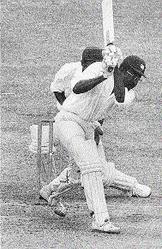
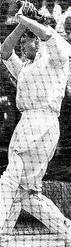
(left) Clive Lloyd (right), Alvin Kallicharran - file


















