FILE
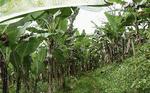
A banana farm in Maroon Town, St. James, where banana is the main crop of the farming community.
Colombia on Thursday filed a complaint at the World Trade Organisation (WTO) against the European Union's import duty for bananas to support neighbouring Ecuador in a similar complaint, an industry source said on Thursday.
"Colombia today has formally filed. They're coming in as a third party (to support Ecuador)," the source told Reuters.
The development came as Dominica was warning that Ecuador's action would be detrimental to the industry in the poorer African Caribbean Pacific (ACP)-producing states, as reported by CMC.
Foreign minister Charles Savarin said it was critical "that the tariff quota which allows duty-free treatment to the ACP bananas on a specified quality of ACP bananas remain in place."
Deep decline
During the period of the original challenge by South American
producers and the United States to the preferential market access that the ACP enjoyed with the EU, Caribbean banana went into deep decline.
In Jamaica for example, the country has seen a 73 per cent fall-off in production in five years - from 43,000 tonnes in 2001 to 11,500 in 2005. Earnings fell from US$18 million to US$4.7 million, a 74 per cent plummet.
The banana-dependent Windward Islands fared even worse.
In 2003, the latest available statistics found online, the Windwards - encompassing St. Lucia as the biggest producer, St. Vincent and the Grenadines, Dominica, and Grenada - exported 67,766 tonnes of bananas, compared to 238,672 tonnes a decade earlier.
Earlier this month, Ecuador, the world's largest banana exporter, launched yet another challenge against Brussels over the EU's single tariff of €176 (US$232.20) a tonne, in force since January 2006, saying it was far too high.
During 2005, while the EU's executive commission was negotiating the level of its new tariff, WTO panels slapped down two previously proposed EU duties of €230 and €187, saying they were too high and discriminated against Latin America (Latam).
The compromise was the single duty of €176.
The single-duty system, to replace a complex arrangement of duties and quotas, was agreed with the WTO to end the 1990s "banana wars" that Europe lost to Ecuador and the United States.
Political solution
Last December, Norwegian Foreign Minister Jonas Gahr Stoere took on the task of overseeing a process of monitoring EU banana imports and prices, with a view to finding a political solution to the tariff problem.
"This is very regrettable," said Michael Mann, European Commission spokesman for agriculture. "We had a consultation process going which we felt was making good progress."
"Latin American banana exports are eight per cent higher this year than they were last year," he said.
Bananas are a sensitive issue for the EU, which gives preferential access to bananas from countries in the ACP group.
ACP bananas enter the EU's lucrative markets free of duty, inside an annual quota of 775,000 tonnes, although anything shipped above that volume attracts the standard €176 duty.
Before the new regime entered into force, Latam exporters paid €75 per tonne, within set quotas, to get their fruit into Europe. Anything above that faced a duty of €680.
Ecuador, earlier this month, made a formal request for 'consultations', which Savarin said is the precursor to formally launching a dispute.
The request circulated to all WTO member states reads: "The Government of Ecuador considers that measures taken by the European communities to comply with the recommendations and rulings of European Communities - Regime for the Importation, Sale and Distribution of Bananas ("Bananas III") are inconsistent with the obligations of the EU under Articles I, II and XIII of the General Agreement on Tariffs and Trade 1994."
Failure to resolve the matter during consultations, said the Dominican foreign minister, would lead to a request for the establishment of a dispute settlement panel by the complainant.
Prior to January 2006, the EU operated a banana import system consisting of tariff quotas totalling 3.113 million tonnes open to all suppliers, and a tariff quota of 750,000 metric tonnes at zero duty open exclusively to ACP suppliers.
Ecuador and the other Latin American banana-producing countries have complained that their exports to the European Union have grown by seven per cent in 2006, while the ACP's volumes have climbed by 20 per cent.
Percentages deceptive
But Savarin said the percentages are deceptive, and that the volumes traded tell a different story.
He said that from January to June 2005, the Latam producers exported 1.58 million tonnes of bananas to the EU, increasing that figure in 2006 to 1.64 million in 2006.
ACP countries, however, traded 367,571 tonnes from January to June in 2005, compared to 436,161 tonnes for the same period in 2006.
"The Windward Islands exports over the same period in 2005 and 2006 were 29,467 tonnes and 35,510 tonnes respectively, while for Dominica exports were 5,932 and 7,222 tonnes, respectively," Savarin said.
Savarin said Ecuador's export of bananas alone to the EU during the period was 525,000 tonnes for January to June 2005, and 539,000 for the corresponding period in 2006.
"Some fear that this action by Ecuador will only have the effect of reigniting and reviving the more than a decade old banana war," he said.
Wire and Sunday Business reports.