Keisha Shakespeare-Blackmore, Staff Reporter
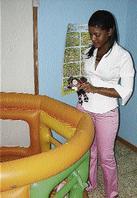
Ashlei McFarlane with one of the dolls she uses in her work with autistic children. - Contributed
For 11 years Jane Mitchell has fought the battle against autism that affects her son, Richard.
He was three years old when he was diagnosed. When he was just over one year old he suddenly stopped talking. He also took up the habit of banging his head against the chair and sofa while rocking back and forth. His mother did not know what was wrong so she took him to see a paediatrician. He told her the boy was just experiencing delayed speech.
Even after she took him back to the same doctor at age three, he gave the same diagnosis. She then took him to an otorhinolaryngologist (ENT specialist), because he had frequent ear infections. "She advised me to check if was deaf, but the test came back negative," said Ms. Mitchell.
Subsequent to her visit to the specialist, she visited a neurologist, then a paediatrician, then she finally discovered he was autistic. The experience she faced after were overwhelming at times. "At first I was devastated, I cried a lot. I kept asking God why me. And when I saw other children his age and younger speaking, I felt really hurt."
Ms. Mitchell had to teach her son social skills such as how to eat. "I even had to label everything in the house so he could learn to identify things."
Even at four years old, Richard was still wearing diapers. He still could not talk, but he screamed a lot. However, he would not cry even if he was punished.
"Though he could not walk or talk he was a brilliant boy, he could solve any jigsaw puzzle his babysitter gave him. She had a challenge finding things to keep him active."
In attempts to cope with Richard's disability Ms. Campbell joined a private voluntary organisation (PVO). The group aids in stimulating children with autism and coach parents on how to handle these children. The PVO's nurse also visits her home and assists her on motivating him. " The nurse recognised that he was brilliant and advised me to send him to school."
Richard started school but he had a difficult time adjusting at first. He screamed constantly and his eating habits were poor. He liked pasta and if he did not get what he wanted he would not eat at all. As he got older, he was moved to another school, but they complained that he was disruptive and destroyed the other children's toys. Nonetheless he spent four years there before being moved to another school. This time the principal complained endlessly and sent the mother a letter stating that she could not take him the following school year as he was not participating in school activities. " I don't know what triggered it."
Talented
Though Richard was a talented and brilliant boy he only started
talking at age six. His speech is still not fluent but he knows how to communicate. He learns songs quickly without being taught - surprising his mother at times. She also noted that he is a very determined boy and she has to speak sternly to him at times. She told Flair that her son has changed her life and her relationship with God. "I have started going to church frequently. And God gives me the strength to be positive."
Despite negative reactions from some family members she loves her son dearly. She has now changed her outlook on life and no longer sees him with autism, but destined to do well.
Tips for parents:
1. Learn about autism so you know how to care for child.
2. Interact with them to find out what triggers negative reactions and how to minimise them.
3. Highly constructive and
organised schedule for the child will help behavioural problems.
4. Seek early interventions.
5. Remain hopeful
Coping Tips:
1. Write a journal.
2. Begin treatment immediately.
3. Talk about what you are feeling to partner, friends or religious leaders.
4. Join support group with others with autistic children.
5. Do something for yourself that you enjoy and which will relax you.
Read FLAIR1 for more about autism